Cinderella · Germany, 1812
Cinderella got crueler with every Grimm edition
The 1812 first edition has a knife and two mutilated feet, but not the famous queen line and not the blinding; Wilhelm Grimm added those seven years later.
I
Start with the book, not the legend
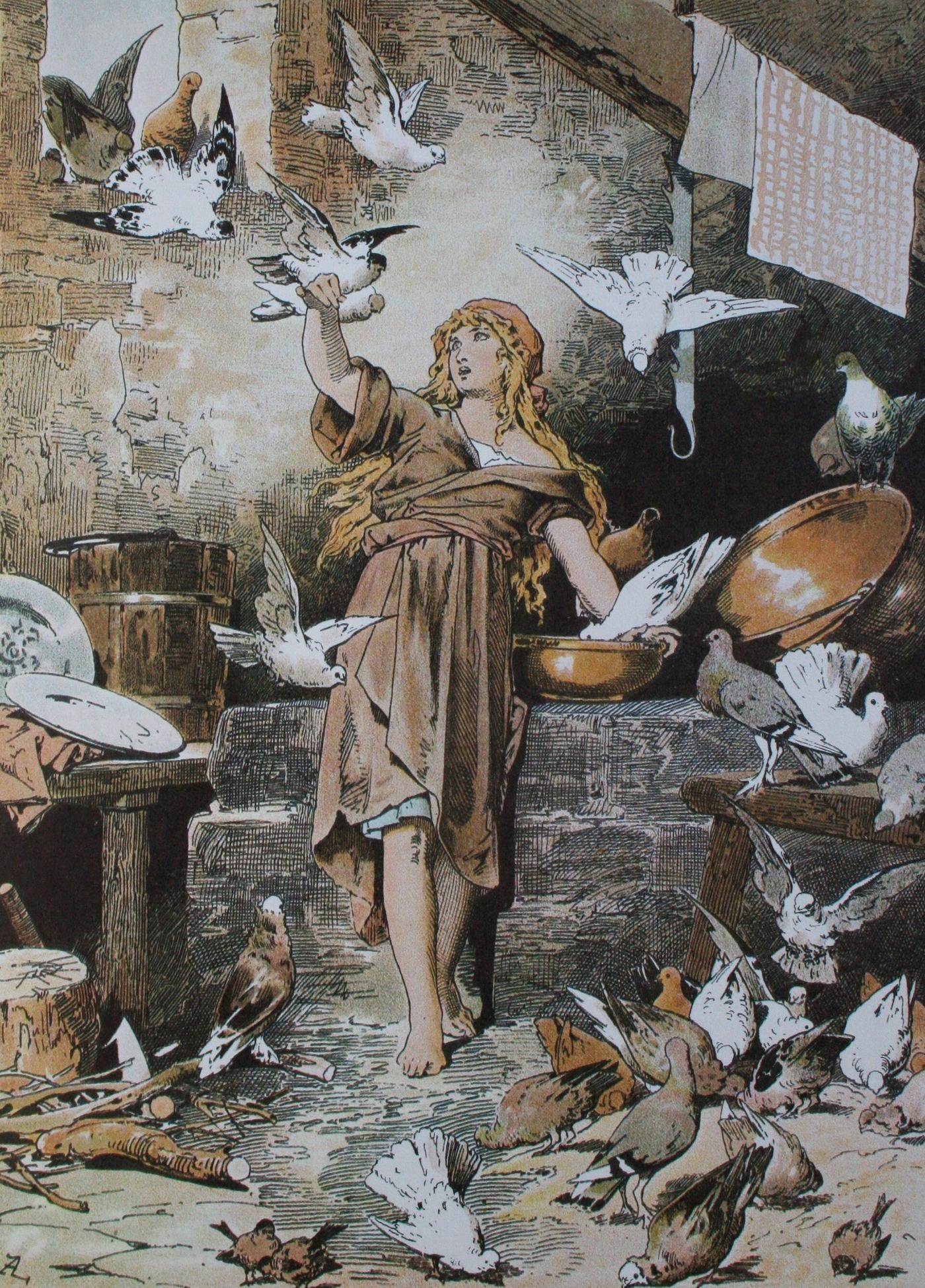
There is no fairy godmother in the Grimms. In the 1812 first edition of Kinder- und Hausmärchen, the help comes from a dying mother and a tree: "liebes Kind, ich muß dich verlassen, aber wenn ich oben im Himmel bin, will ich auf dich herab sehen, pflanz ein Bäumlein auf mein Grab, und wenn du etwas wünschest, schüttele daran, so sollst du es haben." Dear child, I must leave you, but when I am up in heaven I will look down on you; plant a little tree on my grave, and when you wish for something, shake it, and you shall have it.1 The child plants the tree and needs no water for it, "denn es war genug mit seinen Thränen," because her tears were enough.1
The tree is not yet a hazel in 1812. It becomes "das Haselbäumchen, das auf dem Grabe stand," the little hazel standing on the grave, only in the 1819 second edition, and it stays hazel in the final 1857 text.23 The shoe, meanwhile, is gold in every Grimm edition: "der goldene Pantoffel" in 1812, "er war klein und zierlich und ganz golden" in 1857.13 Glass belongs to a different book entirely.
II
The knife is real, and the wording matters
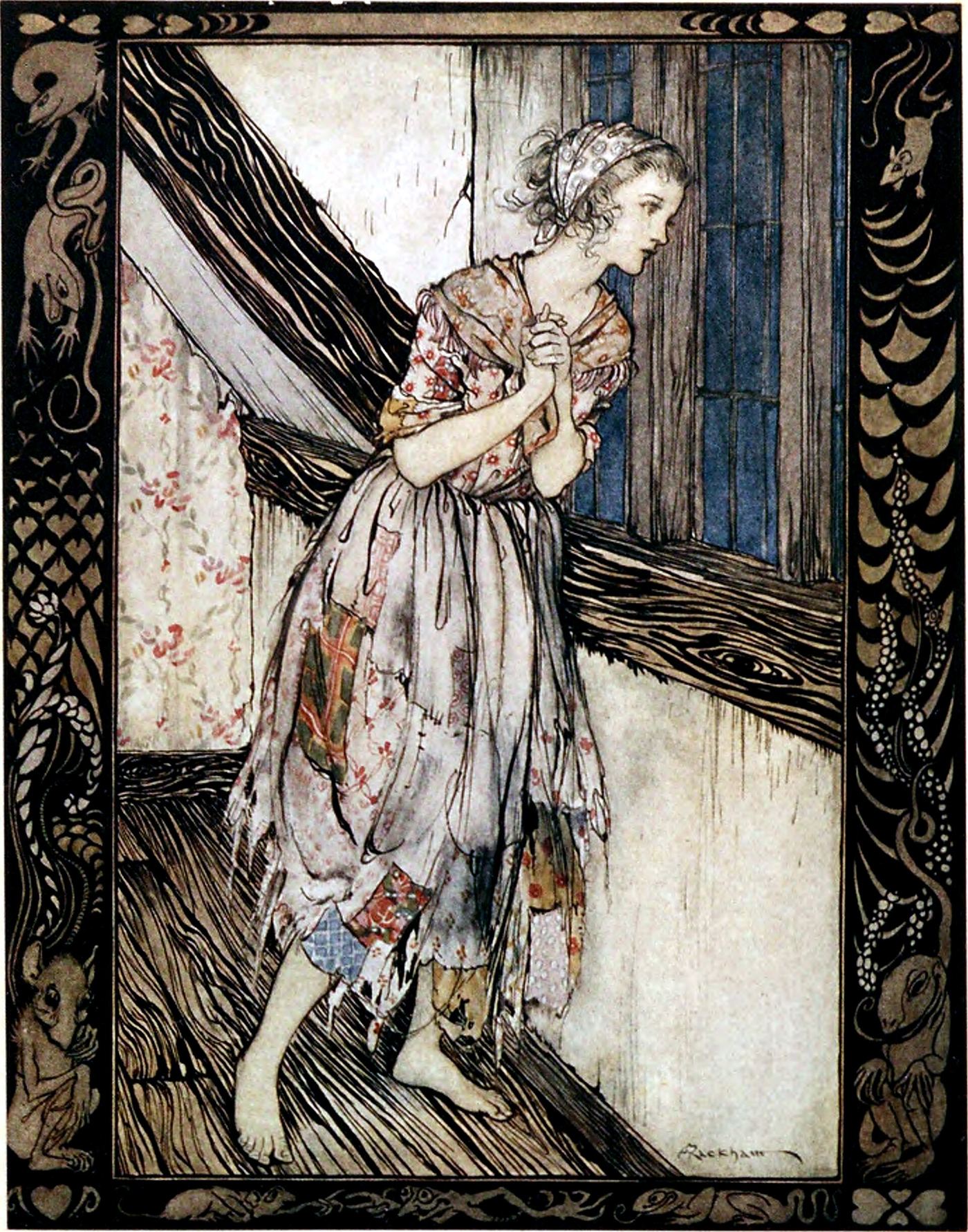
Here is the 1812 sentence that the legend is built on. The stepmother speaks to both daughters at once, quietly, before either goes into her room: "Hört, sagte die Mutter heimlich, da habt ihr ein Messer, und wenn euch der Pantoffel doch noch zu eng ist, so schneidet euch ein Stück vom Fuß ab, es thut ein bischen weh, was schadet das aber, es vergeht bald und eine von euch wird Königin." Listen, said the mother secretly, here is a knife for you, and if the slipper is still too tight, cut a piece off your foot; it hurts a little, but what of it, it passes soon, and one of you will be queen.1
That is not the line everybody quotes. The line everybody quotes is from 1819, where the mother stands beside the eldest in the chamber and says: "hau die Zehe ab, wann du Königin bist, so brauchst du nicht mehr zu Fuß zu gehen." Chop off the toe; when you are queen you will no longer have to go on foot.2 The 1857 text keeps it almost exactly, with a colon in place of the comma.3 So the coldest sentence in Cinderella is not the raw first draft. It is a revision, written by Wilhelm Grimm for the second edition, and the tale kept it for the next four decades.234
III
Heel first, then toes, and reversed later
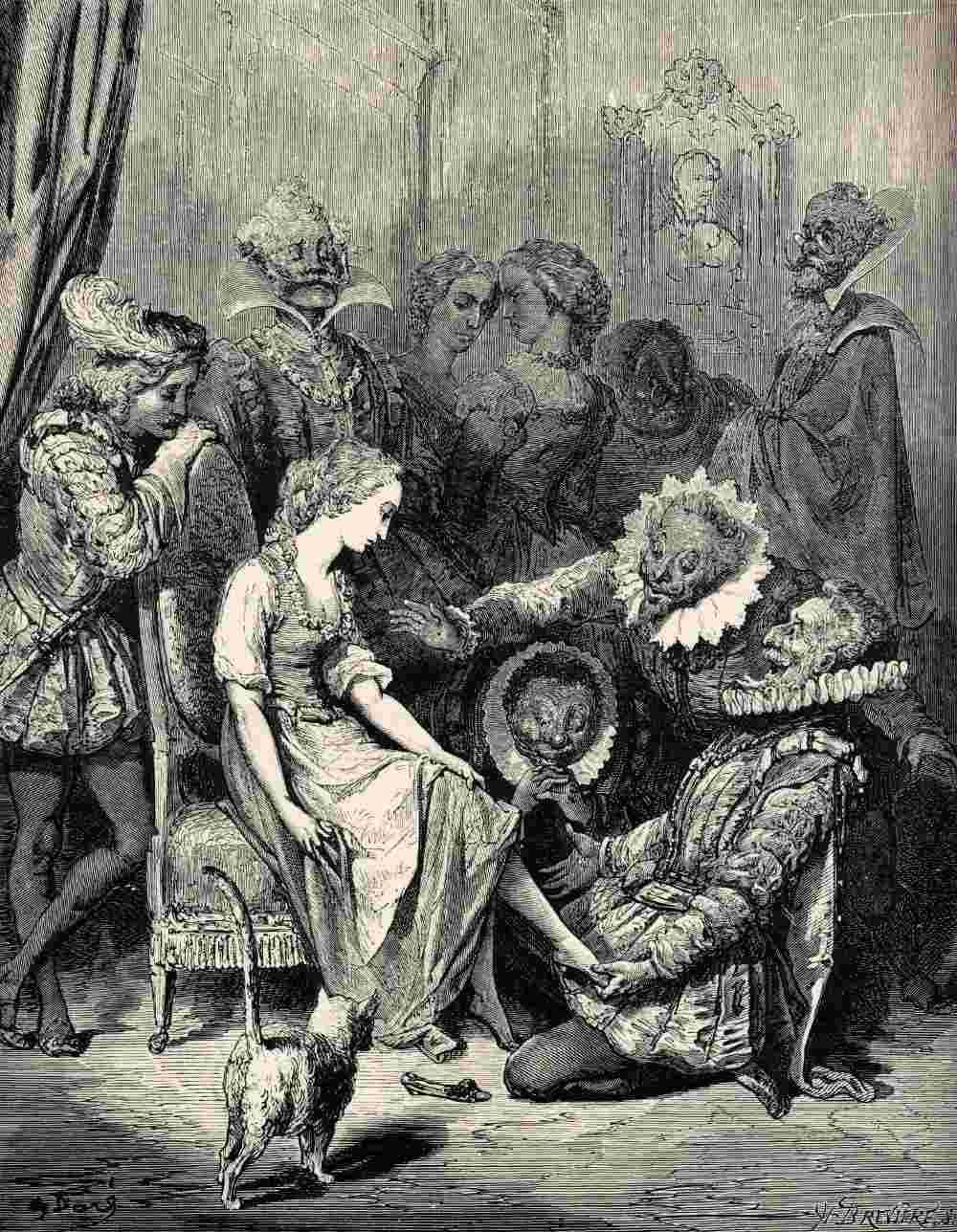
The order changed too. In 1812 the eldest sister's toes go in but her heel will not: "die Fußspitze kam hinein, aber die Ferse war zu groß, da nahm sie das Messer und schnitt sich ein Stück von der Ferse." The second daughter is the one who cuts her toes, on her mother's instruction to "schneide lieber vorne an den Zehen ab."1 From 1819 on, it is the reverse: the eldest loses the toe, the younger a piece of the heel.23
Both times, what exposes the fraud is not the prince's eye. It is two birds. "Rucke di guck, rucke di guck! Blut ist im Schuck: Der Schuck ist zu klein, Die rechte Braut sitzt noch daheim!" Rucke di guck, there is blood in the shoe; the shoe is too small, the right bride is still at home.1 The 1812 printing glosses "Schuck" for the reader as "(Schuh)," shoe.1 Only after the doves call does he look down, and in 1812 "da quoll das Blut heraus," the blood welled out; for the second sister the white stockings have gone red.1 The 1857 text makes that image sharper still: "sah wie das Blut aus dem Schuh quoll und an den weißen Strümpfen ganz roth heraufgestiegen war."3
IV
The blinding was added, and the moral with it
The 1812 tale simply stops. The doves sing "Kein Blut im Schuck: Der Schuck ist nicht zu klein, Die rechte Braut, die führt er heim," no blood in the shoe, he is taking the right bride home, and that is the last line of the story.1 Nobody is punished. Nobody is blinded. No moral is stated.
The ending people describe as the real Grimm ending arrives in 1819 and survives into 1857: at the wedding the doves take one eye from each sister going into the church and the other coming out, "und waren sie also für ihre Bosheit und Falschheit mit Blindheit auf ihr Lebtag gestraft," and so for their wickedness and falsehood they were punished with blindness all their days.23 That closing clause is the moral, and it is a late addition. The 1812 book did not draw it.
V
The glass, the pumpkin, and a much older shoe
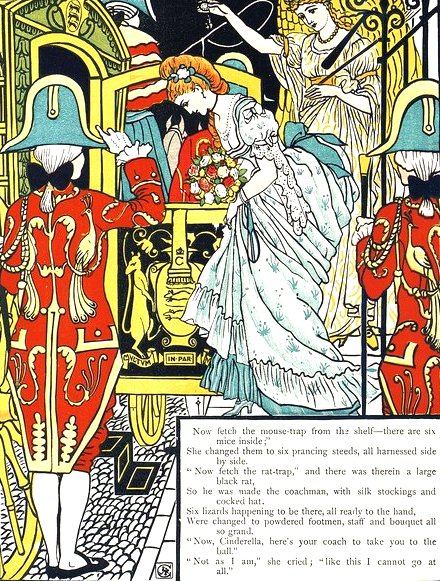
Everything Disney-shaped comes from Paris, not Kassel. The 1697 table of contents of Histoires ou Contes du temps passé lists "Cendrillon, ou la petite pantoufle de verre" at page 117.5 There the godmother is a fairy, "ſa Maraine, qui eſtoit Fée"; the pumpkin becomes the coach, "la citroüille fut auſſi-toſt changée en un beau caroſſe tout doré"; and the slipper goes on without a struggle, "elle y eſtoit juſte comme de cire," it fitted her like wax.5 Perrault's stepsisters are not maimed and not blinded. Cinderella forgives them and lodges them in the palace.5
And the shoe test itself is far older than either book. In the ninth century, Duan Chengshi wrote down a tale he had heard from a household servant: a girl called Ye Xian loses a golden shoe, "躡金履," and the king of Tuohan has every woman in his kingdom try it, "乃令一國婦人履之,竟無一稱者," not one of them a match, until the shoe is traced to her.7 Older still, Strabo reports the Rhodopis story, in which an eagle drops a bathing courtesan's sandal into the king's lap at Memphis and he sends men "in all directions into the country in quest of the woman who wore the sandal."6 There is no fitting test there, and no stepmother, which is why folklorists file it as a relative rather than the original.8
Notes
-
Jacob Grimm and Wilhelm Grimm, "Aschenputtel," no. 21, in Kinder- und Haus-Märchen, vol. 1, 1st ed. (Berlin: Realschulbuchhandlung, 1812), 88-101, transcribed at Wikisource, https://de.wikisource.org/wiki/Aschenputtel_(1812) (page images and transcription fetched 16 September 2026; quotations from pp. 88-89, 98-101). ↩↩↩↩↩↩↩↩↩
-
Jacob Grimm and Wilhelm Grimm, "Aschenputtel," no. 21, in Kinder- und Haus-Märchen, vol. 1, 2nd ed. (Berlin: Reimer, 1819), 119-122, transcribed at Wikisource, https://de.wikisource.org/wiki/Aschenputtel_(1819). ↩↩↩↩↩
-
Jacob Grimm and Wilhelm Grimm, "Aschenputtel," no. 21, in Kinder- und Haus-Märchen, vol. 1, 7th ed., Ausgabe letzter Hand (Göttingen: Dieterich, 1857), 119-126, transcribed at Wikisource, https://de.wikisource.org/wiki/Aschenputtel_(1857) (quotations from pp. 124-126). ↩↩↩↩↩↩↩
-
D. L. Ashliman, trans., "Cinderella," from the Grimms' seventh edition (1857), in Grimm Brothers' Children's and Household Tales, University of Pittsburgh, https://sites.pitt.edu/~dash/grimm021.html. ↩
-
Charles Perrault, "Cendrillon, ou la petite pantoufle de verre," in Histoires ou Contes du temps passé, avec des moralitez (Paris: Claude Barbin, 1697), 117-148, with the title as listed in the volume's own table of contents, transcribed at Wikisource, https://fr.wikisource.org/wiki/Histoires_ou_Contes_du_temps_pass%C3%A9_(1697)/Original/Cendrillon and https://fr.wikisource.org/wiki/Histoires_ou_Contes_du_temps_pass%C3%A9_(1697)/Original/Table. ↩↩↩
-
Strabo, Geography 17.1.33, trans. Horace Leonard Jones, Loeb Classical Library (Cambridge, MA: Harvard University Press), digitized at Bill Thayer's LacusCurtius, University of Chicago, https://penelope.uchicago.edu/Thayer/E/Roman/Texts/Strabo/17A3*.html. ↩
-
Duan Chengshi 段成式, "Ye Xian" 葉限, in Youyang zazu 酉陽雜俎, xuji 續集, juan 1 ("Zhi nuo gao shang" 支諾皋上), 9th century, transcribed at Chinese Wikisource, https://zh.wikisource.org/wiki/%E9%85%89%E9%99%BD%E9%9B%9C%E4%BF%8E/%E7%BA%8C%E9%9B%86/%E5%8D%B7%E4%B8%80. The text closes by naming its teller, "成式舊家人李士元聽說," heard from Li Shiyuan, a former servant of Duan's household. ↩
-
D. L. Ashliman, ed., "Cinderella: Folktales of Aarne-Thompson-Uther Type 510A," University of Pittsburgh, https://sites.pitt.edu/~dash/type0510a.html, which notes that the Rhodopis story "is often cited as the earliest variant of a Cinderella folktale" but "lacks the prototypical motif of the persecuted heroine mistreated by her stepmother and stepsisters." ↩
Bibliography
Ashliman, D. L., ed. "Cinderella: Folktales of Aarne-Thompson-Uther Type 510A." University of Pittsburgh. https://sites.pitt.edu/~dash/type0510a.html.
Ashliman, D. L., trans. "Cinderella." From Kinder- und Hausmärchen, 7th ed. (1857). University of Pittsburgh. https://sites.pitt.edu/~dash/grimm021.html.
Duan Chengshi 段成式. "Ye Xian" 葉限. In Youyang zazu 酉陽雜俎, xuji 續集, juan 1. 9th century. Chinese Wikisource. https://zh.wikisource.org/wiki/%E9%85%89%E9%99%BD%E9%9B%9C%E4%BF%8E/%E7%BA%8C%E9%9B%86/%E5%8D%B7%E4%B8%80.
Grimm, Jacob, and Wilhelm Grimm. "Aschenputtel." No. 21 in Kinder- und Haus-Märchen, vol. 1, 1st ed. Berlin: Realschulbuchhandlung, 1812. Wikisource. https://de.wikisource.org/wiki/Aschenputtel_(1812).
Grimm, Jacob, and Wilhelm Grimm. "Aschenputtel." No. 21 in Kinder- und Haus-Märchen, vol. 1, 2nd ed. Berlin: Reimer, 1819. Wikisource. https://de.wikisource.org/wiki/Aschenputtel_(1819).
Grimm, Jacob, and Wilhelm Grimm. "Aschenputtel." No. 21 in Kinder- und Haus-Märchen, vol. 1, 7th ed. Göttingen: Dieterich, 1857. Wikisource. https://de.wikisource.org/wiki/Aschenputtel_(1857).
Perrault, Charles. "Cendrillon, ou la petite pantoufle de verre." In Histoires ou Contes du temps passé, avec des moralitez. Paris: Claude Barbin, 1697. Wikisource. https://fr.wikisource.org/wiki/Histoires_ou_Contes_du_temps_pass%C3%A9_(1697)/Original/Cendrillon.
Strabo. Geography 17.1.33. Translated by Horace Leonard Jones. Loeb Classical Library. Digitized at LacusCurtius, University of Chicago. https://penelope.uchicago.edu/Thayer/E/Roman/Texts/Strabo/17A3*.html.
Named but not consulted
- Giambattista Basile, "La Gatta Cenerentola," Pentamerone 1.6. The Grimms' own 1812 appendix points to it as the finer telling, but I did not fetch the text.
- Grimm, Kinder- und Haus-Märchen, vol. 3 (1856), the commentary volume on tale 21. Not fetched; only the shorter 1812 appendix note was read.
- Marian Roalfe Cox, Cinderella: Three Hundred and Forty-Five Variants (1893). Not fetched.
- Anne Anderson's Cinderella illustrations. A Commons search returned no file attributable to her, so none is listed below.
- Walt Disney Productions, Cinderella (1950). Named only as a comparison; not consulted.
Image credits
Alexander Zick, Aschenputtel, late 19th century. Public domain.
Arthur Rackham, in C. S. Evans, Cinderella, London: Heinemann, 1919. Public domain.
Gustave Doré, engraving for Perrault's Cendrillon, 19th century. Public domain.
Walter Crane, Cinderella, 1897 printing. University of Florida Digital Collections via Wikimedia Commons. Public domain.