Peter Pan · London, 1911
Peter Pan's own narrator says the boys get killed
Barrie's 1911 novel really does say Peter "thins them out," but the line is stranger than murder, and Captain Hook was never a Lost Boy.
I
The sentence is real, and the viral version gets it slightly wrong
Chapter 5 of Peter and Wendy, the 1911 novel, introduces the Lost Boys with a sentence most people remember from no film: "The boys on the island vary, of course, in numbers, according as they get killed and so on; and when they seem to be growing up, which is against the rules, Peter thins them out; but at this time there were six of them, counting the twins as two."1 Two things matter here. First, this is the narrator speaking, not a character making a threat, and Barrie slides it in between a joke about arithmetic and an invitation to "lie here among the sugar-cane" and watch.1 Second, the version passed around online trims it. Barrie wrote "in numbers, according as they get killed," and "which is against the rules." Getting the words right costs nothing and is the whole difference between reporting and rumour.
II
What "thins them out" can and cannot mean
Barrie never explains the phrase, and that is the point.1 The chapter gives you no exile, no ceremony, no bodies. What it does give you, two chapters later, is a habit. Peter goes out alone, "and when he came back you were never absolutely certain whether he had had an adventure or not. He might have forgotten it so completely that he said nothing about it; and then when you went out you found the body."3 The same chapter says that in the middle of a fight Peter "would suddenly change sides," calling out "I'm redskin to-day; what are you, Tootles?"3 Asked by John whether he kills many, Peter answers "Tons."5 The book will not tell you what happens to a boy who grows up. It tells you instead that Peter treats life and death as a game whose rules he writes, and that the other boys accept those rules. They are forbidden even to look like him.1
III
The real horror is that Peter forgets
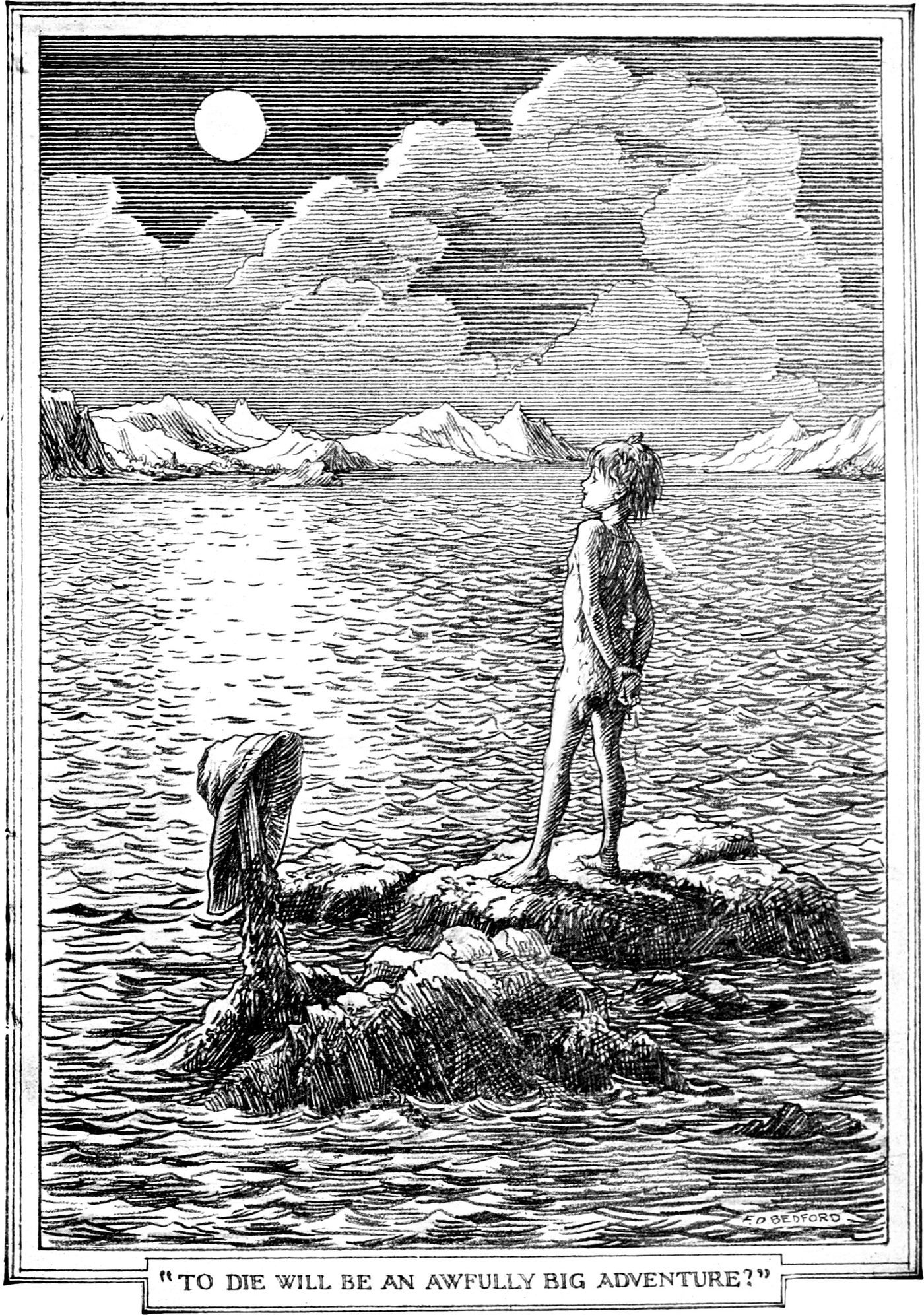
The famous line is not the cruellest thing in the novel. Chapter 8 leaves Peter alone on a rock in a rising sea, and the drum beating within him says, "To die will be an awfully big adventure."4 But go to the last chapter. Wendy, grown, mentions the arch enemy, and Peter asks with interest, "Who is Captain Hook?" She is amazed: "Don't you remember, how you killed him and saved all our lives?" Peter replies, "I forget them after I kill them."9 He has forgotten Tinker Bell too.9 The book ends with Wendy's daughter and then her granddaughter flying off for spring cleaning, "and so it will go on, so long as children are gay and innocent and heartless."9 Heartless is Barrie's word, and he means it kindly and coldly at once.
IV
Hook was not a Lost Boy. He was an Eton boy
The internet's favourite question, that Hook might be a Lost Boy who escaped, has nothing behind it. The novel says the opposite. "Hook was not his true name. To reveal who he really was would even at this date set the country in a blaze; but as those who read between the lines must already have guessed, he had been at a famous public school."7 As he dies, his mind is "slouching in the playing fields of long ago, or being sent up for good, or watching the wall-game from a famous wall," and the wall game is played at one school only.8 In 1927 Barrie went to Eton and said so out loud, arguing that "Hook was a good Etonian though not a great one."11 The villain of Peter Pan is not a boy Peter failed. He is a grown-up with a house tie.
V
Where the darkness actually lives
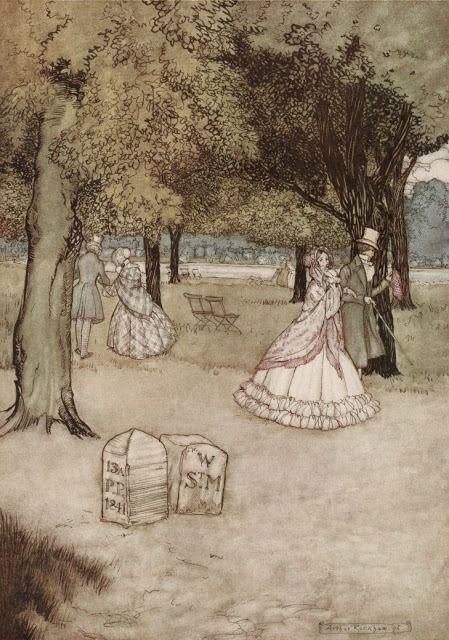
If you want the passage that should frighten people, it is older than Neverland. In The Little White Bird (1902), and again in Peter Pan in Kensington Gardens (1906), Barrie writes that when Peter arrives too late for a child locked in the park at night, "he digs a grave for the child and erects a little tombstone, and carves the poor thing's initials on it." He puts the stones in twos "because they seem less lonely," and names two of them: Walter Stephen Matthews and Phoebe Phelps, who "had fallen unnoticed from their perambulators."10 The Lost Boys fall out of perambulators too.2 Barrie gave his Peter Pan rights to a children's hospital in 1929.13 He knew exactly which children he was writing about.
Notes
-
J. M. Barrie, Peter and Wendy (London: Hodder & Stoughton, 1911), chap. 5, "The Island Come True," https://en.wikisource.org/wiki/Peter_and_Wendy_(1911)/Chapter_5 (page images of the 1911 first edition); cross-checked against Project Gutenberg ebook 16, https://www.gutenberg.org/cache/epub/16/pg16.txt. ↩↩↩↩
-
Barrie, Peter and Wendy, chap. 3, "Come Away, Come Away!," https://en.wikisource.org/wiki/Peter_and_Wendy_(1911)/Chapter_3. ↩
-
Barrie, Peter and Wendy, chap. 7, "The Home Under the Ground," https://en.wikisource.org/wiki/Peter_and_Wendy_(1911)/Chapter_7. ↩↩
-
Barrie, Peter and Wendy, chap. 8, "The Mermaids' Lagoon," https://en.wikisource.org/wiki/Peter_and_Wendy_(1911)/Chapter_8. ↩
-
Barrie, Peter and Wendy, chap. 4, "The Flight," https://en.wikisource.org/wiki/Peter_and_Wendy_(1911)/Chapter_4. ↩
-
Barrie, Peter and Wendy, chap. 1, "Peter Breaks Through" ("when children died he went part of the way with them, so that they should not be frightened"), https://en.wikisource.org/wiki/Peter_and_Wendy_(1911)/Chapter_1. ↩
-
Barrie, Peter and Wendy, chap. 14, "The Pirate Ship," https://en.wikisource.org/wiki/Peter_and_Wendy_(1911)/Chapter_14. ↩
-
Barrie, Peter and Wendy, chap. 15, "'Hook or Me This Time,'" https://en.wikisource.org/wiki/Peter_and_Wendy_(1911)/Chapter_15. ↩
-
Barrie, Peter and Wendy, chap. 17, "When Wendy Grew Up," https://en.wikisource.org/wiki/Peter_and_Wendy_(1911)/Chapter_17. The 1911 first edition reads "and so it will go on"; the Project Gutenberg text (ebook 16) reads "and thus it will go on." ↩↩↩
-
J. M. Barrie, Peter Pan in Kensington Gardens, illus. Arthur Rackham (London: Hodder & Stoughton, 1906), chap. 6, "Peter's Goat," Project Gutenberg ebook 26998, https://www.gutenberg.org/cache/epub/26998/pg26998.txt; the same passage appears in J. M. Barrie, The Little White Bird; or, Adventures in Kensington Gardens (1902), chap. 18, Project Gutenberg ebook 1376, https://www.gutenberg.org/cache/epub/1376/pg1376.txt. ↩
-
J. M. Barrie, "Captain Hook at Eton," address to the First Hundred at Eton College, 7 July 1927, first printed in The Times, 8 July 1927, https://en.wikisource.org/wiki/Captain_Hook_at_Eton. ↩
-
J. M. Barrie, Peter Pan; or, The Boy Who Would Not Grow Up (New York: Charles Scribner's Sons, 1928), Project Gutenberg ebook 78131, https://www.gutenberg.org/cache/epub/78131/pg78131.txt. A full-text search of this edition finds the Lost Boys' perambulator line but no "thins them out" sentence. No survey of film adaptations was carried out for this page. ↩
-
"Peter Pan at Great Ormond Street Hospital," Great Ormond Street Hospital, https://www.gosh.nhs.uk/about-us/our-history/peter-pan-at-great-ormond-street-hospital/, and "The Peter Pan story," GOSH Charity, https://www.gosh.org/about-us/peter-pan/. ↩
Bibliography
Barrie, J. M. "Captain Hook at Eton." Address at Eton College, 7 July 1927. First printed in The Times, 8 July 1927. https://en.wikisource.org/wiki/Captain_Hook_at_Eton.
Barrie, J. M. Peter and Wendy. London: Hodder & Stoughton, 1911. https://en.wikisource.org/wiki/Peter_and_Wendy_(1911); Project Gutenberg ebook 16, https://www.gutenberg.org/ebooks/16.
Barrie, J. M. Peter Pan in Kensington Gardens. Illustrated by Arthur Rackham. London: Hodder & Stoughton, 1906. Project Gutenberg ebook 26998. https://www.gutenberg.org/ebooks/26998.
Barrie, J. M. Peter Pan; or, The Boy Who Would Not Grow Up. New York: Charles Scribner's Sons, 1928. Project Gutenberg ebook 78131. https://www.gutenberg.org/ebooks/78131.
Barrie, J. M. The Little White Bird; or, Adventures in Kensington Gardens. Project Gutenberg ebook 1376. https://www.gutenberg.org/ebooks/1376.
Great Ormond Street Hospital. "Peter Pan at Great Ormond Street Hospital." https://www.gosh.nhs.uk/about-us/our-history/peter-pan-at-great-ormond-street-hospital/.
Great Ormond Street Hospital Children's Charity. "The Peter Pan Story: Theatre, Panto, Schools and More." https://www.gosh.org/about-us/peter-pan/.
Named but not consulted
- Barrie, J. M. M'Connachie and J. M. B.: Speeches by J. M. Barrie. London: Peter Davies, 1938. The print collection in which "Captain Hook at Eton" was reprinted. Not fetched; the 1927 text was read on Wikisource instead.
- Walt Disney Productions. Peter Pan. 1953. Named in the claim about adaptations. Not viewed or scripted-checked, so no claim about it is made here.
- Birkin, Andrew. J. M. Barrie and the Lost Boys. Often cited for Barrie's biography. Not used for any claim on this page.
Image credits
F. D. Bedford, in J. M. Barrie, Peter and Wendy, London: Hodder & Stoughton, 1911. Public domain.
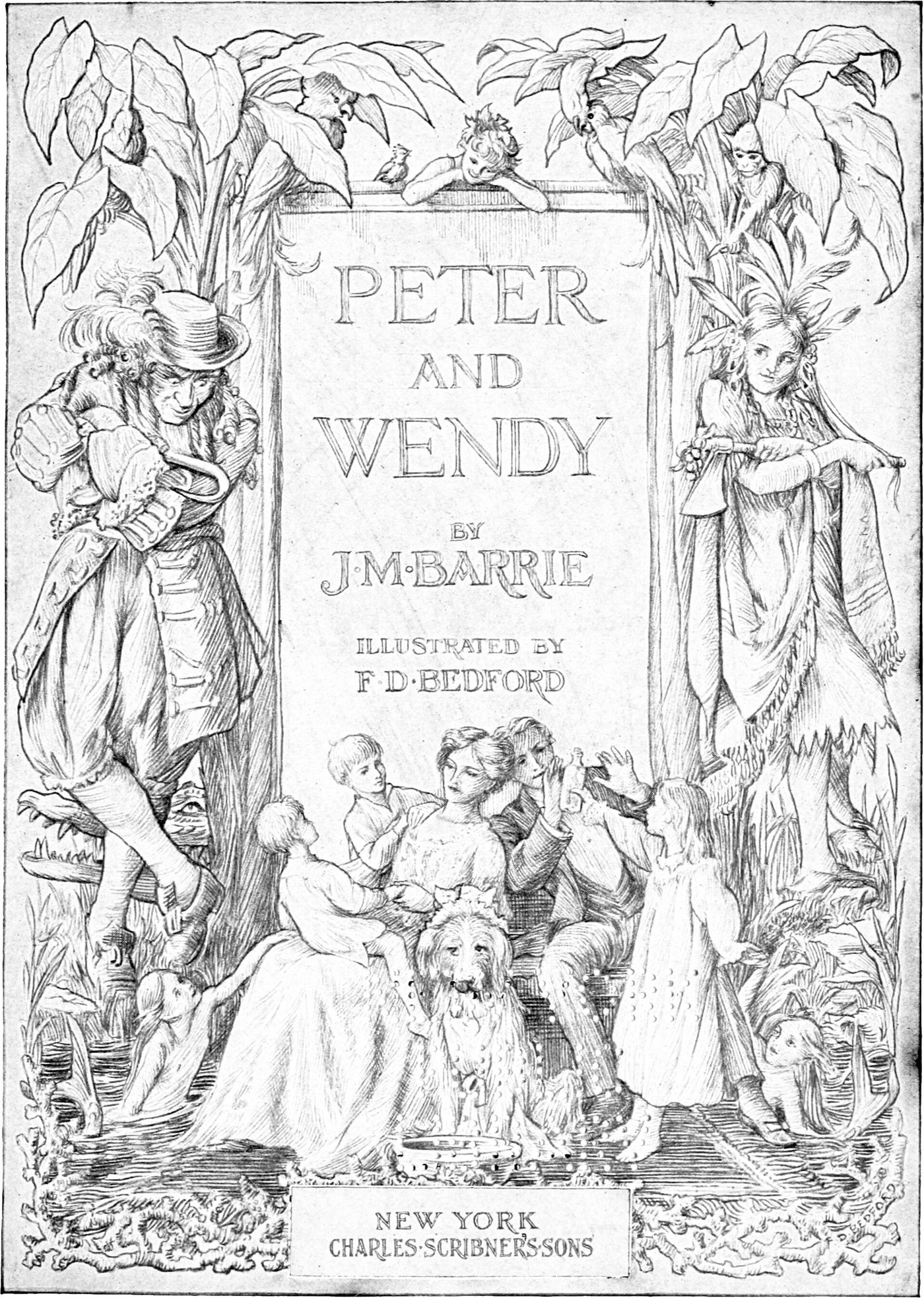
Title page, Peter and Wendy, New York: Scribner's, 1911. Public domain.
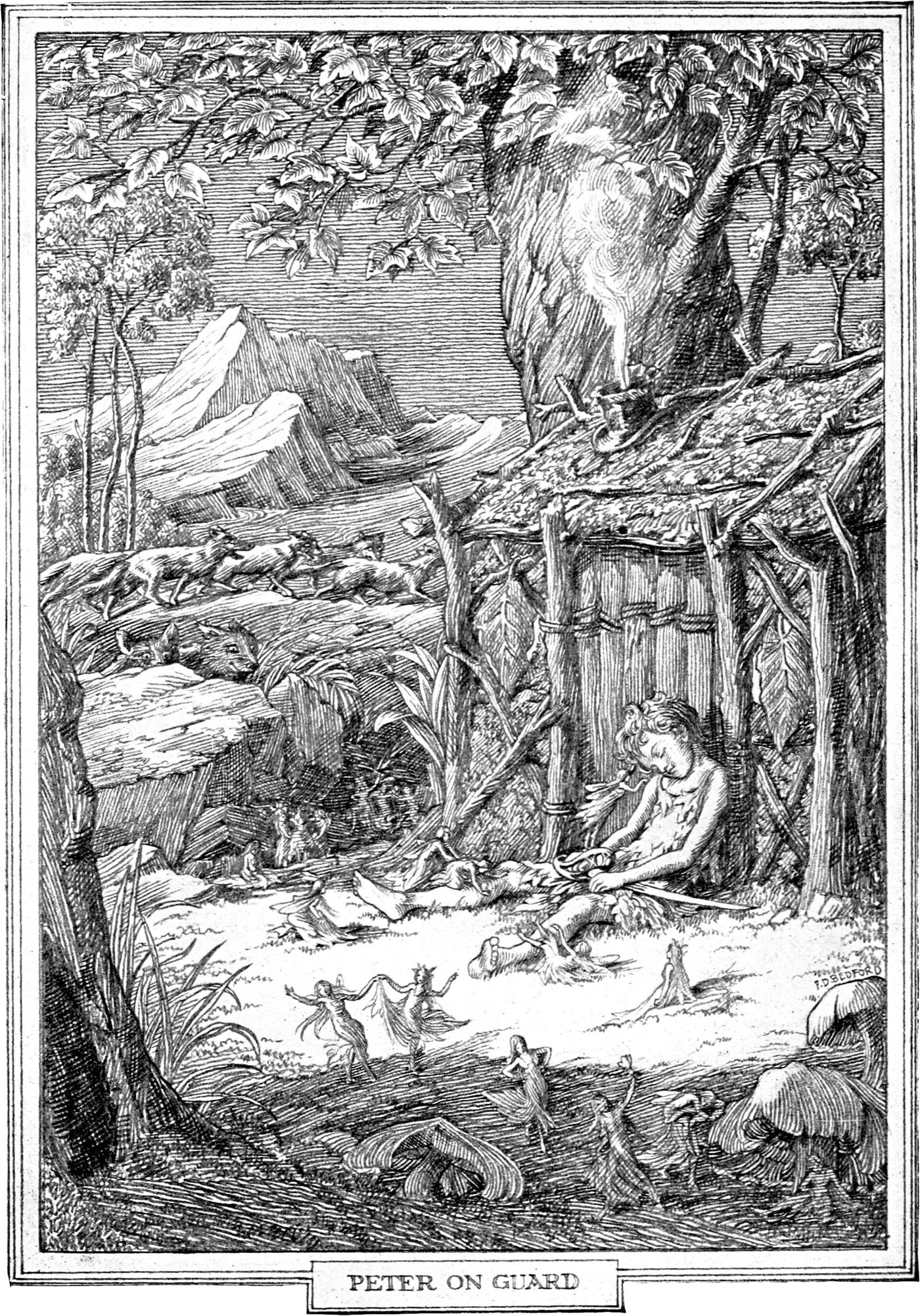
F. D. Bedford, Peter and Wendy, 1911. Public domain.
Arthur Rackham, Peter Pan in Kensington Gardens, London: Hodder & Stoughton, 1906. Public domain.