Sleeping Beauty · Naples, 1636
Sleeping Beauty's kiss is a Grimm invention, not Disney's
The 1636 Neapolitan original has no kiss, no prince and no poison, and it ends by congratulating the lucky rather than warning the vulnerable.
I
The date on the box is wrong
Basile's collection was published in five instalments, one per "day," after his death. The first day went to press in Naples in 1634 with Ottavio Beltrano.9 Talia's story is the fifth tale of the fifth day, and Croce's bibliography records that volume as "Jornata quinta. In Napoli, appresso Ottavio Beltrano, 1636," with the dedication dated 20 July 1636.8 So 1636 is the year for this tale. The collection as a whole spans 1634 to 1636.
The heroine is not a princess either. She is the daughter of "no gran signore," a great lord, and there is no offended fairy. Her father calls in astrologers, who conclude "ca passava gran pericolo pe na resta de lino" ("that she would pass through great danger because of a splinter of flax").1 There is no poison anywhere in the tale. The danger is the flax itself: a fibre gets under her fingernail while she plays with a spindle, "e cadette morta 'n terra" ("and she fell down dead on the ground").1
II
What the king actually does
A king out hunting loses a falcon into the abandoned palace, climbs a vintner's ladder to get it back, and finds her. Basile writes it in one long breath:
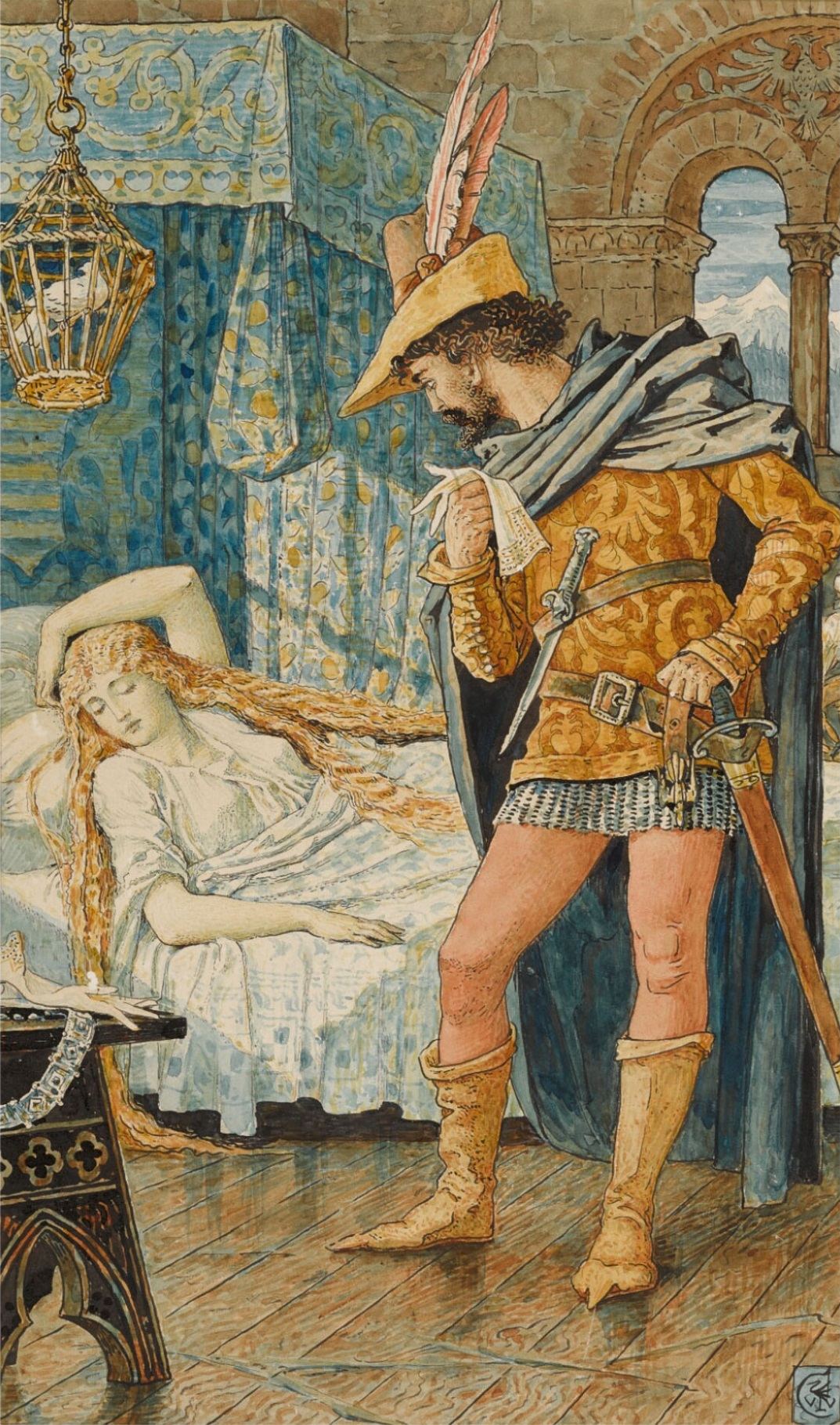
"non revenenno pe quanto facesse e gridasse e pigliato de caudo de chelle bellezze, portatola de pesole a no lietto ne couze li frutte d'ammore e, lassatola corcata, se ne tornaie a lo regno suio, dove non se allecordaie pe no piezzo de chesto che l'era socciesso."2
"She did not come round however much he did and shouted, and, taken by the heat of that beauty, he carried her bodily to a bed and gathered the fruits of love, and, leaving her lying there, he went back to his own kingdom, where for a good while he did not remember what had happened to him."2
Benedetto Croce's Italian renders the same clause "la portò di peso sopra un letto e ne colse i frutti d'amore."4 Richard Burton's 1893 English keeps the same euphemism: "He lifted her in his arms, and carried her to a bed, where he gathered the first fruits of love."3 She is unconscious throughout. She does not consent, and she is not asked. Basile spends one clause on it and moves on.
III
The babies wake her, not a man
Nine months later she gives birth, still asleep, to a boy and a girl. Two fairies appear and put the newborns to her breast. Then:
"Li quale, na vota, volenno zucare né trovanno lo capetiello, l'afferraro lo dito e tanto zucaro che ne tiraro l'aresta, pe la quale cosa parze che se scetasse da no gran suonno."5
"Once, wanting to suck and not finding the nipple, they seized her finger and sucked so hard that they drew out the splinter, and so it seemed that she woke from a great sleep."5
Two details matter here. Both babies do it, not one. And what comes out is the flax splinter, "l'aresta," the same fibre that put her down. Nothing is poisoned and nothing is kissed.
IV
The horror is in the second half
The king remembers her, visits, and tells her who he is. His wife, the queen, finds out. Basile calls her "chillo core de Medea," that heart of Medea. She sends for the children in the king's name and "commannaie a lo cuoco che l'avesse scannate e fattone deverse menestrelle e saponelle, pe farele magnare a lo nigro marito" ("ordered the cook to cut their throats and make various little stews and sauces of them, to feed to her wretched husband").6 The cook hides the children and serves two kid goats instead. The queen then tries to burn Talia alive, and the king burns the queen instead.
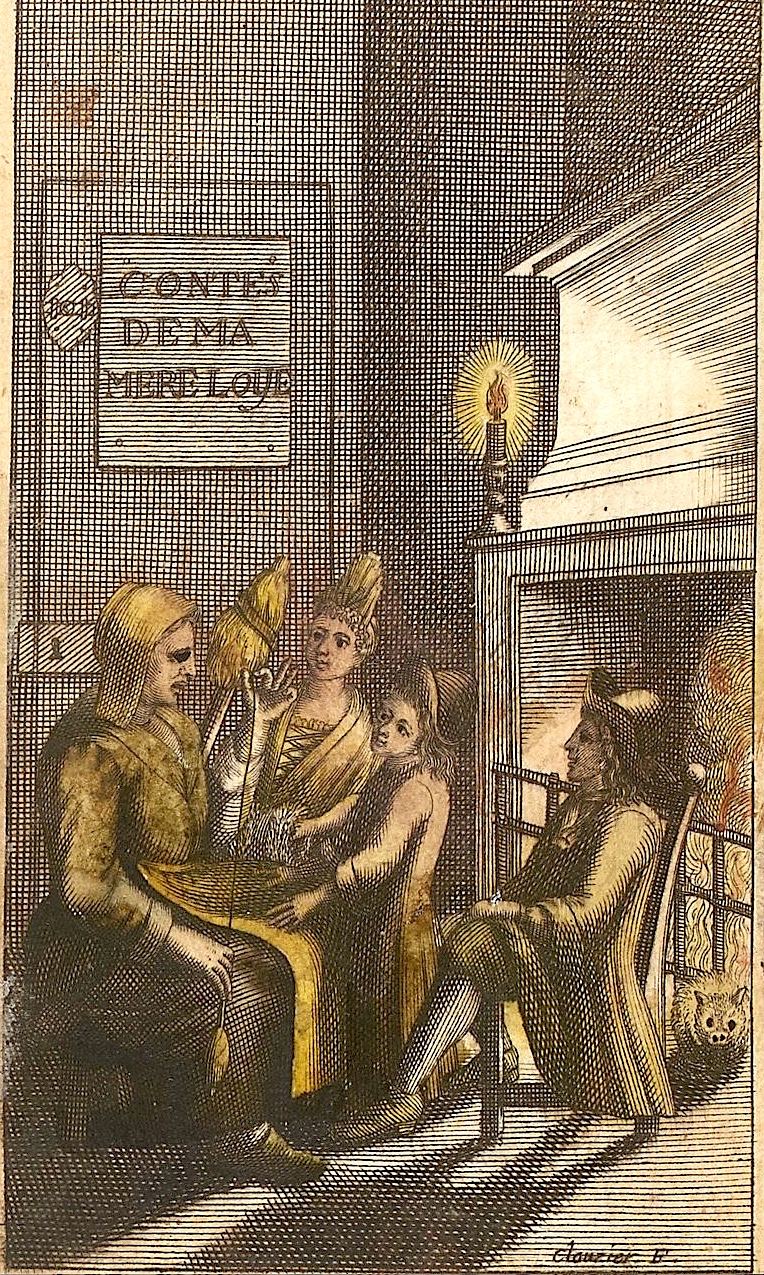
Perrault keeps this machinery in 1697 and moves it to a mother-in-law of ogre stock. Her line is one of the coldest in French: "je veux manger demain à mon dîner la petite Aurore," and then, "je la veux manger à la sauce Robert" ("tomorrow I want to eat little Aurore for my dinner... I want her in sauce Robert").11 The maître d'hôtel substitutes a lamb, then a kid, then a hind.
V
Where the kiss comes from
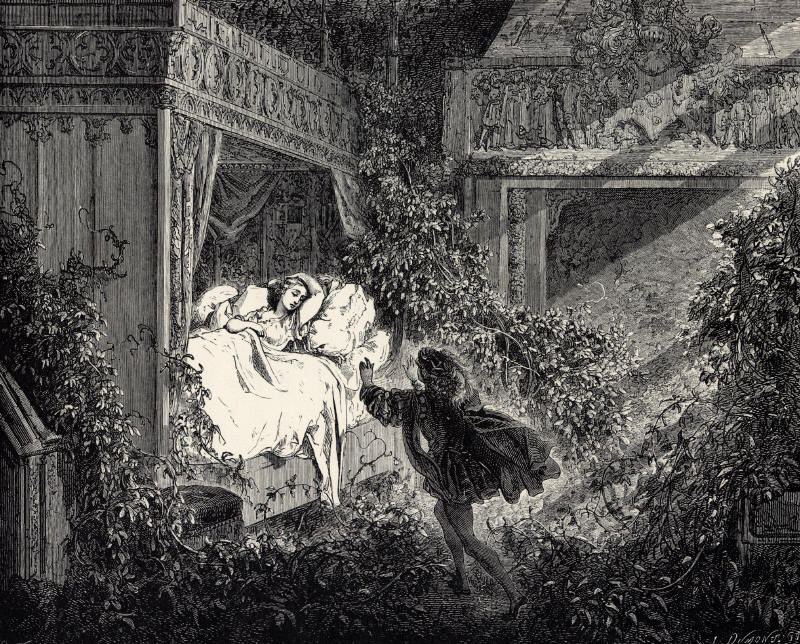
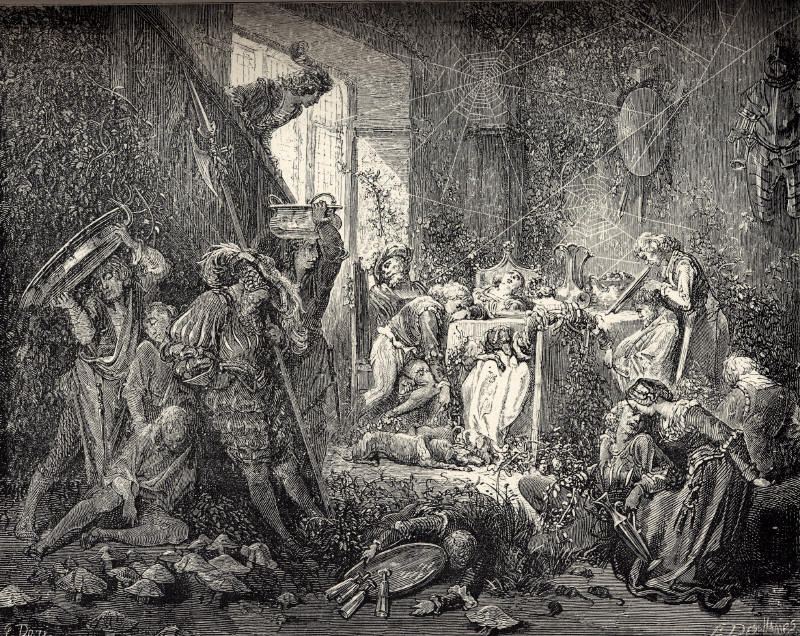
In Perrault's 1697 text the prince does not kiss her. He kneels: "Il s'approcha en tremblant et en admirant, et se mit à genoux auprès d'elle. Alors, comme la fin de l'enchantement estoit venuë, la Princesse s'éveilla" ("He came near, trembling and admiring, and knelt down beside her. Then, the end of the enchantment having come, the Princess awoke").10 The hundred years are up. That is all.
The kiss enters with the Grimms, in the first edition of 1812: "Da war der Königssohn so erstaunt über ihre Schönheit, daß er sich bückte und sie küßte, und in dem Augenblick wachte sie auf" ("Then the king's son was so astonished at her beauty that he bent down and kissed her, and in that moment she awoke").13 The Grimms also cut the cannibal second half entirely; their tale ends at the wedding.13 Their own note names Perrault as the parallel.14
Which leaves the moral. Basile's tale closes on a proverb, and it is not a warning: "canoscenno a tutte botte ca a chi ventura tene / quanno dorme perzì chiove lo bene" ("knowing at every turn that for the one who has luck, good rains down even while he sleeps").7 Burton's version: "Those whom fortune favors / Find good luck even in their sleep."3 Perrault's single moral is a joke about impatient brides, not a caution about predators.12 The darkness in these tales is real. The lesson the internet attaches to it is not in the books.
Notes
-
Giambattista Basile, "Sole, Luna e Talia," in Lo cunto de li cunti, ed. Michele Rak (Milan: Garzanti, 1995), digital edition, Letteratura italiana Einaudi, 443, https://archive.org/download/cuntodelicuntilogiovanbattistabasile/Cunto%20de%20li%20cunti%20%28Lo%29%20-%20Giovan%20Battista%20Basile_djvu.txt. ↩↩
-
Basile, "Sole, Luna e Talia," in Lo cunto de li cunti, ed. Rak, 443-44, https://archive.org/download/cuntodelicuntilogiovanbattistabasile/Cunto%20de%20li%20cunti%20%28Lo%29%20-%20Giovan%20Battista%20Basile_djvu.txt. ↩↩
-
Giambattista Basile, "Sun, Moon, and Talia," in Il Pentamerone; or, The Tale of Tales, trans. Richard F. Burton, vol. 2 (London: Henry and Company, 1893), day 5, tale 5, 518-25, revised by D. L. Ashliman, https://sites.pitt.edu/~dash/type0410.html. ↩↩
-
Giambattista Basile, "Sole, Luna e Talia," in Il Pentamerone ossia La fiaba delle fiabe, trans. Benedetto Croce, vol. 2 (Bari: Gius. Laterza & Figli, 1925), 298-99, https://archive.org/details/locuntodelicunti02basi. ↩
-
Basile, "Sole, Luna e Talia," in Lo cunto de li cunti, ed. Rak, 444, https://archive.org/download/cuntodelicuntilogiovanbattistabasile/Cunto%20de%20li%20cunti%20%28Lo%29%20-%20Giovan%20Battista%20Basile_djvu.txt. ↩↩
-
Basile, "Sole, Luna e Talia," in Lo cunto de li cunti, ed. Rak, 445, https://archive.org/download/cuntodelicuntilogiovanbattistabasile/Cunto%20de%20li%20cunti%20%28Lo%29%20-%20Giovan%20Battista%20Basile_djvu.txt. ↩
-
Basile, "Sole, Luna e Talia," in Lo cunto de li cunti, ed. Rak, 448, https://archive.org/download/cuntodelicuntilogiovanbattistabasile/Cunto%20de%20li%20cunti%20%28Lo%29%20-%20Giovan%20Battista%20Basile_djvu.txt. ↩
-
Benedetto Croce, introduction to Giambattista Basile, Lo cunto de li cunti (Il Pentamerone): Testo conforme alla prima stampa del MDCXXXIV-VI, ed. Benedetto Croce, vol. 1, Biblioteca napoletana di storia e letteratura (Naples, 1891; printed Trani: V. Vecchi), xciii-xciv n., https://archive.org/details/locuntodelicunt00basigoog. ↩
-
Croce, introduction to Lo cunto de li cunti, ed. Croce, 1:lxxxvi and n., https://archive.org/details/locuntodelicunt00basigoog. ↩
-
Charles Perrault, "La belle au bois dormant," in Histoires ou contes du temps passé, avec des moralitez (Paris: Claude Barbin, 1697), 1-46, transcribed at Wikisource, https://fr.wikisource.org/wiki/Histoires_ou_Contes_du_temps_pass%C3%A9_(1697)/Original/La_belle_au_bois_dormant. ↩
-
Perrault, "La belle au bois dormant," in Histoires ou contes du temps passé (1697), 1-46, https://fr.wikisource.org/wiki/Histoires_ou_Contes_du_temps_pass%C3%A9_(1697)/Original/La_belle_au_bois_dormant. ↩
-
Perrault, "Moralité" to "La belle au bois dormant," in Histoires ou contes du temps passé (1697), https://fr.wikisource.org/wiki/Histoires_ou_Contes_du_temps_pass%C3%A9_(1697)/Original/La_belle_au_bois_dormant. ↩
-
Jacob Grimm and Wilhelm Grimm, "Dornröschen," no. 50, in Kinder- und Haus-Märchen, vol. 1, 1st ed. (Berlin: Realschulbuchhandlung, 1812), 225-29, https://de.wikisource.org/wiki/Dornr%C3%B6schen_(1812). ↩↩
-
Grimm and Grimm, "Zu Dornröschen. No. 50," appendix to Kinder- und Haus-Märchen, 1:xxxi, https://de.wikisource.org/wiki/Dornr%C3%B6schen_(1812). ↩
Bibliography
Basile, Giambattista. Il Pentamerone ossia La fiaba delle fiabe. Translated by Benedetto Croce. Vol. 2. Bari: Gius. Laterza & Figli, 1925. https://archive.org/details/locuntodelicunti02basi.
Basile, Giambattista. Il Pentamerone; or, The Tale of Tales. Translated by Richard F. Burton. Vol. 2. London: Henry and Company, 1893. Revised by D. L. Ashliman. https://sites.pitt.edu/~dash/type0410.html.
Basile, Giambattista. Lo cunto de li cunti. Edited by Michele Rak. Milan: Garzanti, 1995. Digital edition, Letteratura italiana Einaudi. https://archive.org/download/cuntodelicuntilogiovanbattistabasile/Cunto%20de%20li%20cunti%20%28Lo%29%20-%20Giovan%20Battista%20Basile_djvu.txt.
Basile, Giambattista. Lo cunto de li cunti (Il Pentamerone): Testo conforme alla prima stampa del MDCXXXIV-VI. Edited with introduction and notes by Benedetto Croce. Vol. 1. Biblioteca napoletana di storia e letteratura. Naples, 1891. Printed Trani: V. Vecchi. https://archive.org/details/locuntodelicunt00basigoog.
Grimm, Jacob, and Wilhelm Grimm. Kinder- und Haus-Märchen. Vol. 1. 1st ed. Berlin: Realschulbuchhandlung, 1812. https://de.wikisource.org/wiki/Dornr%C3%B6schen_(1812).
Perrault, Charles. Histoires ou contes du temps passé, avec des moralitez. Paris: Claude Barbin, 1697. https://fr.wikisource.org/wiki/Histoires_ou_Contes_du_temps_pass%C3%A9_(1697)/Original/La_belle_au_bois_dormant.
Named but not consulted
- Giambattista Basile, Giambattista Basile's The Tale of Tales, or Entertainment for Little Ones, trans. Nancy L. Canepa (Detroit: Wayne State University Press, 2007). Named in the brief. Not opened, not quoted, not cited above.
- The 1636 Beltrano printing of Jornata quinta itself. No digitised copy was reachable. Its imprint and dedication date are reported here from Croce's 1891 bibliographical note, which I did open.
- it.wikisource's Lo cunto de li cunti. It carries only the introduction and days one and two; the page for day five, tale five returned 404 and the site's page list confirms the tale is absent. The Neapolitan text quoted above therefore comes from the Rak edition digitised by Letteratura italiana Einaudi.
Image credits
Gustave Doré, La Belle au bois dormant, 1867 plates. Public domain.
Antoine Clouzier, frontispiece to Perrault, Histoires ou contes du temps passé, 1697. Public domain.
Walter Crane, The Sleeping Beauty, 1882. Public domain.