Snow White · Germany, 1812
In 1812, Snow White's killer was her own mother
Lungs and liver, cooked with salt, and no stepmother anywhere. The first edition is stranger than any retelling, and the strangest part is the one nobody retells.
I
The tale as first printed
The Grimms printed Snow White in Berlin in 1812, as tale 53 of the first volume of Kinder- und Haus-Märchen, under the title "Sneewittchen (Schneeweißchen)."1 It is a short text, and its opening is the part almost nobody knows. A queen sits at a window sewing in the snow, pricks her finger, and wishes for a child as white as snow, red as blood, black as the window frame. She has the child. And then, with no death and no remarriage in between, the text says this:
Die Königin war die schönste im ganzen Land, und gar stolz auf ihre Schönheit. "The queen was the most beautiful in the whole land, and very proud of her beauty."1
The mirror tells her the child has surpassed her, and the queen who wished Snow White into the world orders her killed.
II
Lungs and liver, with salt
The order to the huntsman is exact, and it is not about a heart:
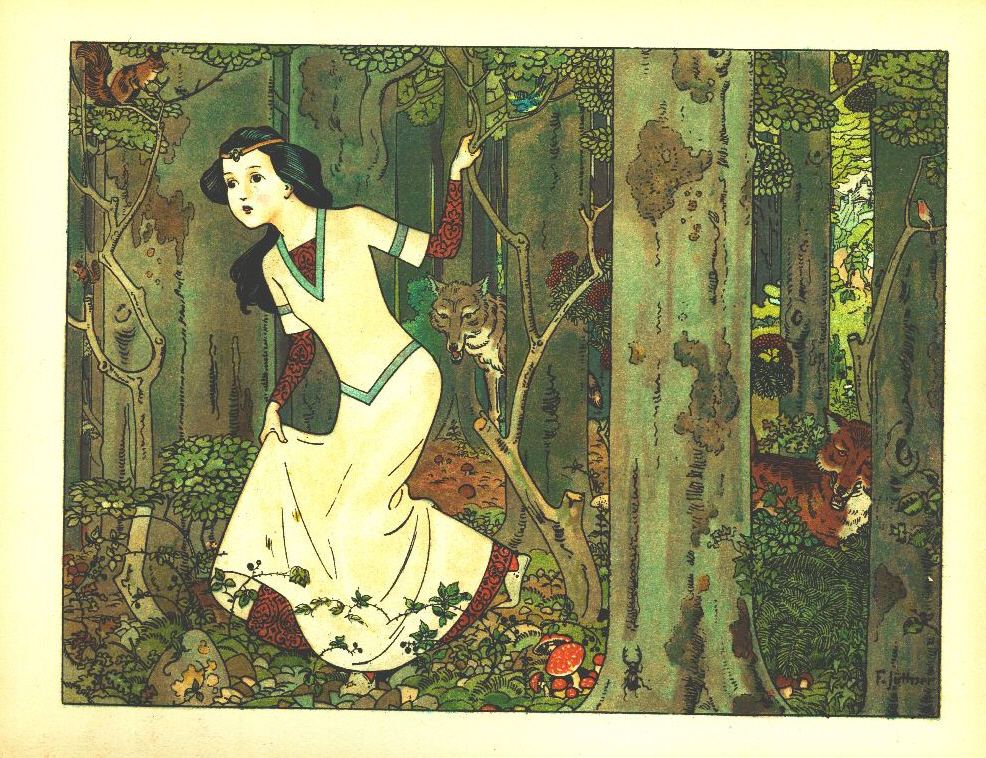
… führ das Sneewittchen hinaus in den Wald an einen weiten abgelegenen Ort, da stichs todt, und zum Wahrzeichen bring mir seine Lunge und seine Leber mit, die will ich mit Salz kochen und essen. "Take Snow White out into the woods to a remote spot, and stab her to death. As proof that she is dead bring her lungs and her liver back to me. I shall cook them with salt and eat them."2
The huntsman lets her go and kills a young boar instead. The queen cooks its organs with salt, eats them, "and believed she had eaten Snow White's lungs and liver."2 This is in every Grimm edition, first to last. In 1857 a cook does the salting and "the wicked woman ate them up."3 What is not in any edition is a reason involving youth. The text names the motive twice, and the word is Neid, envy: she "went pale with envy," and "her envy gave her no rest."1 The idea that she eats the organs to stay young belongs to other legends. It is not in this one.
III
"How her mother had wanted to kill her"
When Snow White reaches the dwarfs' house and tells them what happened, the 1812 text gives the relationship in one word:
… da erzählte es ihnen, wie seine Mutter es habe wollen umbringen, der Jäger ihm aber das Leben geschenkt. "Then she told them how her mother had wanted to kill her, but the huntsman had spared her life."4
Seine Mutter. Her mother. The word Stiefmutter, stepmother, does not occur in the 1812 tale.4 The dwarfs take her in on a bargain, housework for shelter, and give her one warning: beware of the queen, and let nobody in.4 She is not held there. She runs to the house herself, and the dwarfs are her protection against the queen, not her jailers.
IV
1819: the Grimms invent the stepmother
Seven years later, in the second edition, two sentences appear that were not in the first:
Und wie das Kind geboren war, starb die Königin. Ueber ein Jahr nahm sich der König eine andere Gemahlin. "And when the child was born, the queen died. After a year the king took another wife."5
From then on Snow White tells the dwarfs how "her stepmother" wanted to kill her.5 The Harvard folklorist Maria Tatar has said the Grimms "chose to publish the one in which the rival is the stepmother, in part because they did not want to violate the sanctity of motherhood."6 The rewrite made the ending bearable to print, because the ending did not change. At Snow White's wedding, iron slippers are heated glowing in the fire, and the queen "had to put them on and dance in them" until she fell down dead.7 In 1812, that is her mother.
V
Three more things the first edition says
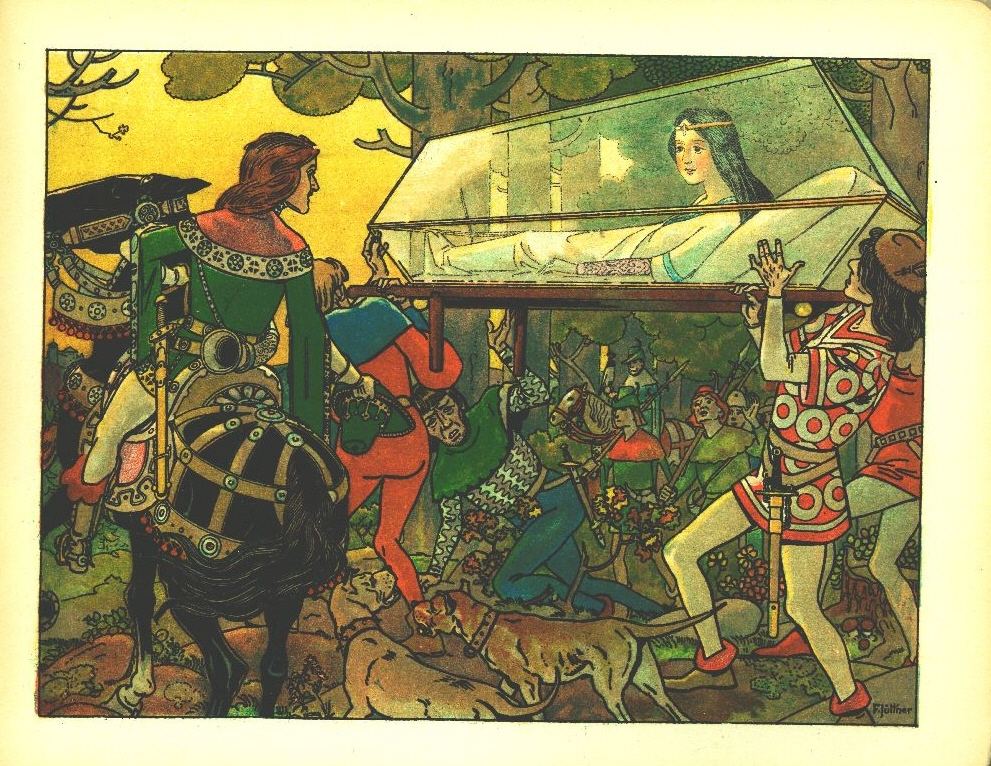
There is no kiss. The prince takes the glass coffin home and cannot eat unless it is in the room; his servants, tired of carrying it, open it, and one of them, annoyed, shoves the girl in the back. The piece of apple flies out of her throat and she wakes.8 In the Grimms' own source notes, one version they collected has no magic mirror at all: Snow White has a dog named Spiegel, "Mirror," who answers the queen's question.9 And the girl is seven years old when the murder is ordered.1
Notes
-
Jacob and Wilhelm Grimm, Kinder- und Haus-Märchen, vol. 1, 1st ed. (Berlin: Realschulbuchhandlung, 1812), no. 53, "Sneewittchen (Schneeweißchen)," 238–50, German Wikisource, https://de.wikisource.org/wiki/Sneewittchen_(Schneewei%C3%9Fchen)_(1812). The motive: "ward sie blaß vor Neid"; "Da ließ ihr der Neid keine Ruhe." The age: "als es sieben Jahr alt war." Translations the author's unless noted. ↩↩↩↩
-
Grimm, Kinder- und Haus-Märchen (1812), no. 53, 239–40: "die kochte sie mit Salz und aß sie auf, und meinte sie hätte Sneewittchens Lunge und Leber gegessen." English: D. L. Ashliman, trans., "Little Snow-White" (1812 text), Folktexts, University of Pittsburgh, https://sites.pitt.edu/~dash/type0709.html. ↩↩
-
Jacob and Wilhelm Grimm, Kinder- und Hausmärchen, vol. 1, 7th ed. (Göttingen: Dieterich, 1857), no. 53, "Sneewittchen," German Wikisource, https://de.wikisource.org/wiki/Sneewittchen_(1857): "Der Koch mußte sie in Salz kochen, und das boshafte Weib aß sie auf." ↩
-
Grimm, Kinder- und Haus-Märchen (1812), no. 53, 241–42: "Das Häuschen gehörte sieben Zwergen, die waren aber nicht zu Haus, sondern in das Bergwerk gegangen"; the bargain, "wenn du unsern Haushalt versehen, und kochen, nähen, betten, waschen und stricken willst … sollst du bei uns bleiben"; the warning, "hüt dich nur vor der Königin und laß niemand herein." ↩↩↩
-
Jacob and Wilhelm Grimm, Kinder- und Haus-Märchen, vol. 1, 2nd ed. (Berlin: Reimer, 1819), "Sneewittchen," 262–67, German Wikisource, https://de.wikisource.org/wiki/Sneewittchen_(1819): "wie es seine Stiefmutter hätte wollen umbringen." ↩↩
-
Maria Tatar, quoted in "The Tale of Snow White and What the Various Versions Mean to Us," Harvard Gazette, July 2020, https://news.harvard.edu/gazette/story/2020/07/the-tale-of-snow-white-and-what-the-various-versions-mean-to-us/. ↩
-
Grimm, Kinder- und Haus-Märchen (1812), no. 53, 250: "da waren eiserne Pantoffeln im Feuer glühend gemacht, die mußte sie anziehen und darin tanzen." ↩
-
Grimm, Kinder- und Haus-Märchen (1812), no. 53, 248–49: "… und gab ihm mit der Hand einen Stumpf in den Rücken. Da fuhr ihm der garstige Apfelgrütz, den es abgebissen hatte, aus dem Hals, und da war Sneewittchen wieder lebendig." ↩
-
Grimm, Kinder- und Haus-Märchen, vol. 1 (1812), Anhang, notes to no. 53, xxxii–xxxiv, transcribed on the same Wikisource page as note 1: the variant with the dog Spiegel and the variant with the count and countess. ↩
Bibliography
Ashliman, D. L., trans. "Little Snow-White" (1812 text). Folktexts, University of Pittsburgh. https://sites.pitt.edu/~dash/type0709.html.
Grimm, Jacob, and Wilhelm Grimm. Kinder- und Haus-Märchen. Vol. 1. 1st ed. Berlin: Realschulbuchhandlung, 1812. German Wikisource.
Grimm, Jacob, and Wilhelm Grimm. Kinder- und Haus-Märchen. Vol. 1. 2nd ed. Berlin: Reimer, 1819. German Wikisource.
Grimm, Jacob, and Wilhelm Grimm. Kinder- und Hausmärchen. Vol. 1. 7th ed. Göttingen: Dieterich, 1857. German Wikisource.
Tatar, Maria. Quoted in "The Tale of Snow White and What the Various Versions Mean to Us." Harvard Gazette, July 2020.
Named but not consulted
Tatar, Maria. The Hard Facts of the Grimms' Fairy Tales. Princeton: Princeton University Press, 1987.
Zipes, Jack, trans. The Original Folk and Fairy Tales of the Brothers Grimm: The Complete First Edition. Princeton: Princeton University Press, 2014.
Image credits
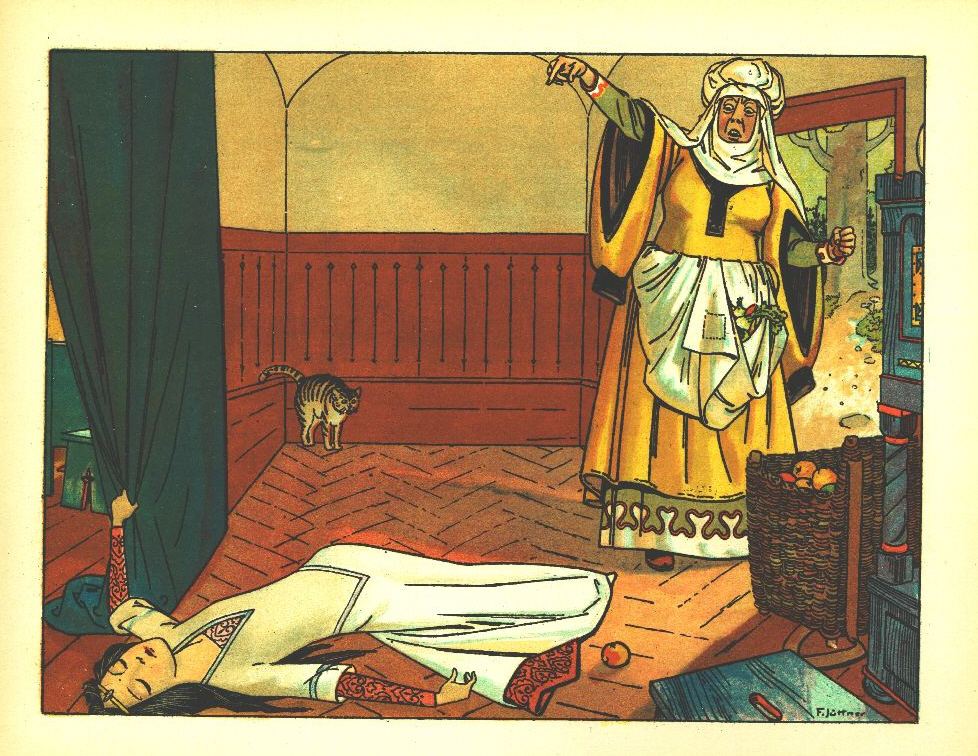
Franz Jüttner, Schneewittchen, Mainz: Scholz, c. 1905. Public domain.
Franz Jüttner, Schneewittchen, c. 1905. Public domain.
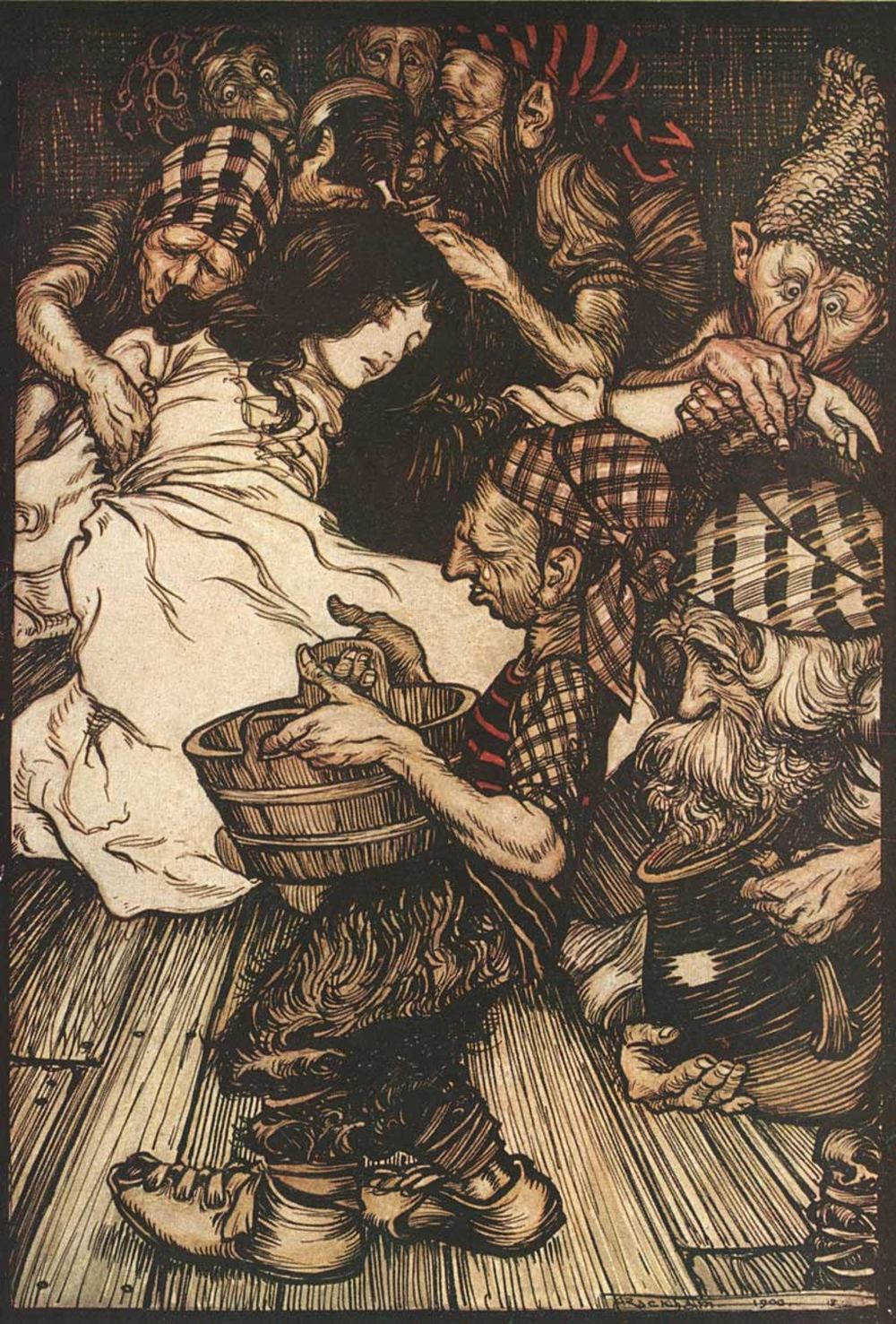
Arthur Rackham, The Fairy Tales of the Brothers Grimm, 1909. Public domain.