The Sun and the Moon · Korea
The tiger's voice never fooled the children
In the Korean tale of the Sun and the Moon the children pass the voice test and the hand test, and the tiger gets in anyway, which is exactly the problem with AI voice cloning today.
I
The tiger does not ask for everything at once
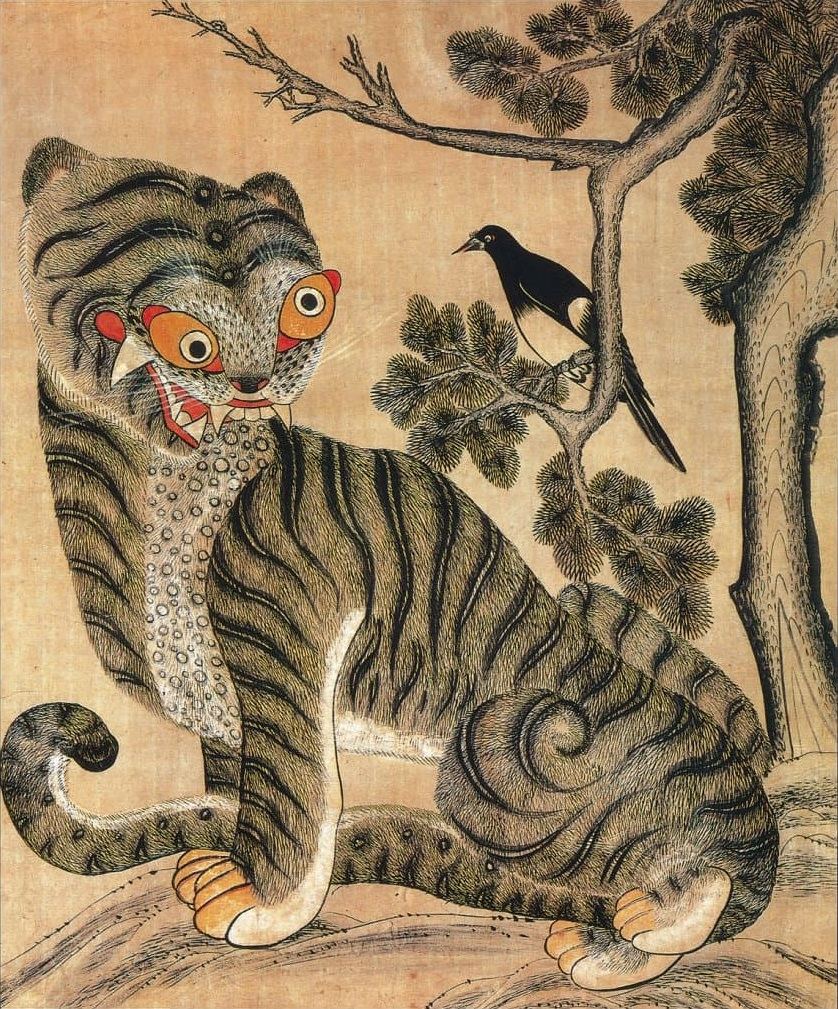
The mother is walking home over a line of mountain passes with rice cakes on her head. A tiger meets her at each one. The Academy of Korean Studies encyclopedia compresses the whole sequence into a single sentence: "호랑이는 고개마다 나타나서 어머니에게 떡, 옷, 팔, 다리, 몸통을 차례로 요구한 뒤 잡아 먹고는 삼 남매가 있는 집으로 갔다," the tiger appeared at every pass and demanded from the mother, in turn, her rice cakes, her clothes, her arms, her legs, her torso, then ate her and went to the house where the three children were.1 The line every Korean child can recite is the tiger's own: "떡 하나 주면 안 잡아먹지," give me one rice cake and I will not eat you.2
Not one big lie, but a staircase of small reasonable-sounding requests. By the time the tiger reaches the house it is wearing the mother's clothes, which is the part every retelling gets right.1
II
The children test, and they pass
Here is where the popular version and the recorded version separate. The encyclopedia is blunt: "아이들은 호랑이의 목소리와 손바닥이 어머니와 다르다고 문을 열어 주지 않았으나," the children did not open the door, because the tiger's voice and its palms were different from their mother's.1 They run the two tests a child can run through a closed door, hearing and touch, and both tests catch the tiger.
What defeats them is not the impersonation. It is a pretext. "호랑이가 우는 젖먹이에게 젖을 먹여야 한다고 하자 문을 열어 주었다," when the tiger said it had to nurse the crying baby, they opened the door.1 Urgency beats verification. In another summary of the tale the children never open at all, spot the tiger through a hole in the door, and escape out the back.3 Either way, the voice is not what wins.
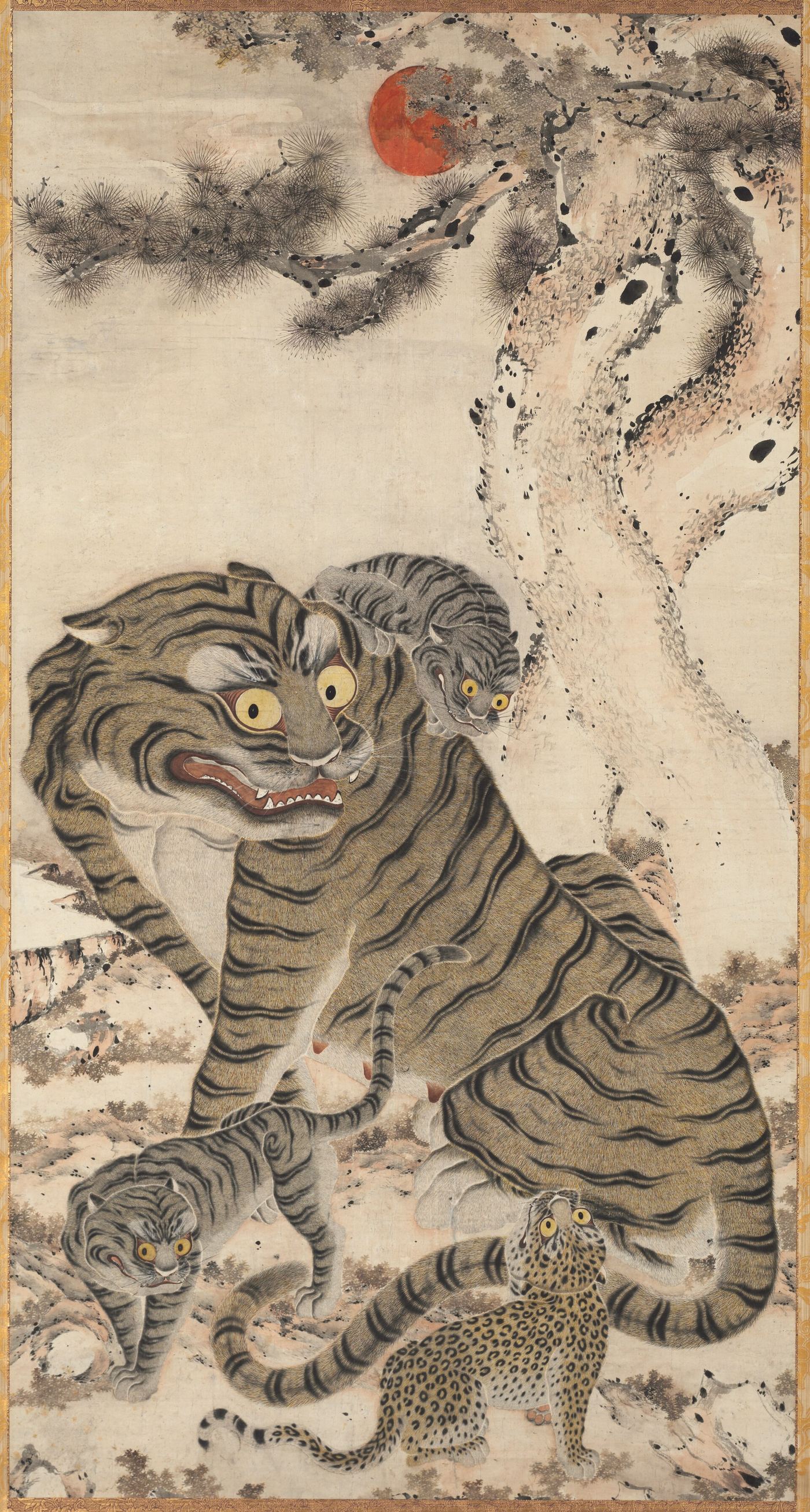
What saves the survivors is not cleverness either. They climb a tree, pray, and a rope comes down from the sky. The tiger prays too and gets a rotten one: "호랑이는 하늘에서 내려온 썩은 동아줄을 잡고 하늘로 오르다가 동아줄이 끊어져 수수밭에 떨어졌다," the tiger climbed the rotten rope, the rope broke, and it fell into a millet field.1 That is why millet stalks are red, and why the sister became the sun and the brother the moon.13 The tale is an origin story with a safety lesson wedged inside it.
III
The same door, in German, in 1857
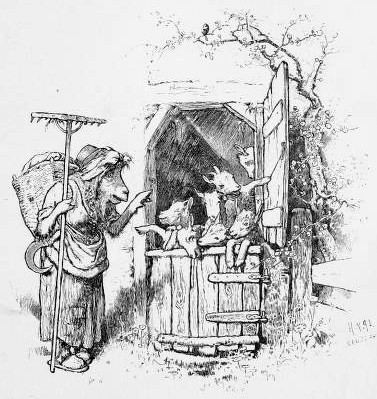
The trick at the door is not Korean property. It is tale type ATU 123, "The Wolf and the Kids," and the best known version is Grimm KHM 5, in print since 1812.4 The 1857 text hands the children a checklist before the mother leaves: "Der Bösewicht verstellt sich oft, aber an seiner rauhen Stimme und an seinen schwarzen Füßen werdet ihr ihn gleich erkennen," the villain often disguises himself, but you will know him at once by his rough voice and his black feet.5
Round one, the voice fails him: "du bist unsere Mutter nicht, die hat eine feine und liebliche Stimme, aber deine Stimme ist rauh; du bist der Wolf."5 So he upgrades. "Da gieng der Wolf fort zu einem Krämer, und kaufte sich ein großes Stück Kreide: die aß er und machte damit seine Stimme fein," the wolf went to a shopkeeper, bought a large piece of chalk, ate it, and made his voice fine.5 Round two, the black paw in the window gives him away, so he has a baker spread dough on it and a miller dust it with white flour.5 Round three, the kids do the smart thing and demand proof: "zeig uns erst deine Pfote, damit wir wissen daß du unser liebes Mütterchen bist," first show us your paw so we know you are our dear little mother.5 He shows it. It is white. They open the door.
That is a nineteenth-century spoofing arms race. Every marker the children trust gets forged in turn, and asking for proof through the same channel the attacker controls is not verification at all.
IV
How old is "ancient"
Old orally, young on paper. The first Korean printing of the story appears to be 1922, in the magazine 개벽, under the title 해와 달, by the writer Ju Yo-seop.2 The English summary of the Encyclopedia of Korean Folk Culture entry reports that the earliest recorded telling was narrated by O Su-hwa in South Gyeongsang Province in 1911 and later printed in English by Zong In-sob.3 I could not reach folkency.nfm.go.kr from here to read that entry directly, so the 1911 date is reported at second hand and the colonial-era Japanese collections often named alongside it are not cited here at all.6
V
What the tiger sounds like now
The Federal Trade Commission described the modern version in March 2023: "A scammer could use AI to clone the voice of your loved one. All he needs is a short audio clip of your family member's voice, which he could get from content posted online, and a voice-cloning program."7 The FBI put it in a fraud alert on December 3, 2024: "Criminals generate short audio clips containing a loved one's voice to impersonate a close relative in a crisis situation, asking for immediate financial assistance or demanding a ransom."8 Imposter scams cost Americans $2.95 billion in reported losses in 2024, the second largest category after investment fraud, out of more than $12.5 billion total.9
Both agencies give the same fix. The FTC: "Don't trust the voice. Call the person who supposedly contacted you and verify the story. Use a phone number you know is theirs."7 The FBI: "Create a secret word or phrase with your family to verify their identity."8 Hang up. Use a channel the tiger does not control. Neither source mentions cloned voices talking anyone into opening a literal front door, so do not let anyone sell you that detail.
Notes
-
최인학 [Choe In-hak], "해와 달이 된 오누이" [Brother and sister who became the sun and moon], 한국민족문화대백과사전 [Encyclopedia of Korean Culture] (Seongnam: Academy of Korean Studies), accessed September 16, 2026, https://encykorea.aks.ac.kr/Article/E0062663. Quoted sentences from the 내용 section: "호랑이는 고개마다 나타나서 어머니에게 떡, 옷, 팔, 다리, 몸통을 차례로 요구한 뒤 잡아 먹고는 삼 남매가 있는 집으로 갔다"; "아이들은 호랑이의 목소리와 손바닥이 어머니와 다르다고 문을 열어 주지 않았으나"; "호랑이가 우는 젖먹이에게 젖을 먹여야 한다고 하자 문을 열어 주었다"; "호랑이는 하늘에서 내려온 썩은 동아줄을 잡고 하늘로 오르다가 동아줄이 끊어져 수수밭에 떨어졌다." Page reached and quoted via automated fetch; the entry's own reference list names 한국구비문학대계 and the 임석재 collection. ↩↩↩↩↩↩
-
"해와 달이 된 오누이," 위키백과 [Korean Wikipedia], article wikitext retrieved September 16, 2026, https://ko.wikipedia.org/wiki/해와_달이_된_오누이. Source of the tiger's refrain "떡 하나 주면 안 잡아먹지" and of the statement "출판된 것은 1922년 잡지 《개벽》에 실린 주요섭의 《해와 달》이 최초이다." Encyclopedia-grade for the refrain, second hand for the 1922 date. ↩↩
-
"The Brother and Sister Who Became the Sun and Moon," Wikipedia, article wikitext retrieved September 16, 2026, https://en.wikipedia.org/wiki/The_Brother_and_Sister_Who_Became_the_Sun_and_Moon. Summarizes the Encyclopedia of Korean Folk Culture entry by 조현설 and the Encyclopedia of Korean Culture entry by 최인학; source of the sentence "The earliest recorded and reported material ... is The Sun and the Moon (written by Zong In Sob), narrated by O Su-hwa in South Gyeongsang Province in 1911," and of the variant in which the siblings see the tiger through a hole in the door and escape out the back. Used only where no primary text was reachable. ↩↩↩
-
"The Wolf and the Seven Young Goats," Wikipedia, article wikitext retrieved September 16, 2026, https://en.wikipedia.org/wiki/The_Wolf_and_the_Seven_Young_Goats: "It is of Aarne-Thompson type 123 'The Wolf and the Kids,'" citing Hans-Jörg Uther, The Types of International Folktales (Helsinki, 2004), 94-95. The Uther volume itself was not consulted. ↩
-
Jacob Grimm and Wilhelm Grimm, "Der Wolf und die sieben jungen Geislein," in Kinder- und Haus-Märchen, Band 1, 7th ed. (Göttingen: Dieterich, 1857), 26-29, transcribed at German Wikisource, retrieved September 16, 2026, https://de.wikisource.org/wiki/Der_Wolf_und_die_sieben_jungen_Geislein_(1857). Quoted: "Der Bösewicht verstellt sich oft, aber an seiner rauhen Stimme und an seinen schwarzen Füßen werdet ihr ihn gleich erkennen"; "du bist unsere Mutter nicht, die hat eine feine und liebliche Stimme, aber deine Stimme ist rauh; du bist der Wolf"; "Da gieng der Wolf fort zu einem Krämer, und kaufte sich ein großes Stück Kreide: die aß er und machte damit seine Stimme fein"; "streu mir weißes Mehl auf meine Pfote"; "zeig uns erst deine Pfote, damit wir wissen daß du unser liebes Mütterchen bist." The Wikisource header records KHM 5 since 1812. ↩↩↩↩↩
-
Attempted and failed: https://folkency.nfm.go.kr/en/main and https://folkency.nfm.go.kr/kr/topic/detail/6006, the Encyclopedia of Korean Folk Culture. Every request from this machine returned a connection refusal or timed out on September 16, 2026. Nothing in this article is cited to that site. ↩
-
Alvaro Puig, "Scammers Use AI to Enhance Their Family Emergency Schemes," Federal Trade Commission Consumer Alert, March 20, 2023, https://consumer.ftc.gov/consumer-alerts/2023/03/scammers-use-ai-enhance-their-family-emergency-schemes. Quoted: "A scammer could use AI to clone the voice of your loved one. All he needs is a short audio clip of your family member's voice, which he could get from content posted online, and a voice-cloning program"; "Don't trust the voice. Call the person who supposedly contacted you and verify the story. Use a phone number you know is theirs." ↩↩
-
Federal Bureau of Investigation, Internet Crime Complaint Center, "Criminals Use Generative Artificial Intelligence to Facilitate Financial Fraud," Alert Number I-120324-PSA, December 3, 2024, https://www.ic3.gov/PSA/2024/PSA241203. Quoted: "Criminals generate short audio clips containing a loved one's voice to impersonate a close relative in a crisis situation, asking for immediate financial assistance or demanding a ransom"; "Create a secret word or phrase with your family to verify their identity"; "Verify the identity of the person calling you by hanging up the phone, researching the contact of the bank or organization purporting to call you, and call the phone number directly." ↩↩
-
Federal Trade Commission, "New FTC Data Show a Big Jump in Reported Losses to Fraud to $12.5 Billion in 2024," press release, March 10, 2025, https://www.ftc.gov/news-events/news/press-releases/2025/03/new-ftc-data-show-big-jump-reported-losses-fraud-125-billion-2024. Quoted: "consumers reported losing more than $12.5 billion to fraud in 2024, which represents a 25% increase over the prior year"; "The second highest reported loss amount came from imposter scams, with $2.95 billion reported lost"; "The FTC received fraud reports from 2.6 million consumers last year." The release does not break out voice-cloning losses separately. ↩
Bibliography
"The Brother and Sister Who Became the Sun and Moon." Wikipedia. Retrieved September 16, 2026. https://en.wikipedia.org/wiki/The_Brother_and_Sister_Who_Became_the_Sun_and_Moon.
Federal Bureau of Investigation, Internet Crime Complaint Center. "Criminals Use Generative Artificial Intelligence to Facilitate Financial Fraud." Alert Number I-120324-PSA, December 3, 2024. https://www.ic3.gov/PSA/2024/PSA241203.
Federal Trade Commission. "New FTC Data Show a Big Jump in Reported Losses to Fraud to $12.5 Billion in 2024." Press release, March 10, 2025. https://www.ftc.gov/news-events/news/press-releases/2025/03/new-ftc-data-show-big-jump-reported-losses-fraud-125-billion-2024.
Grimm, Jacob, and Wilhelm Grimm. "Der Wolf und die sieben jungen Geislein." In Kinder- und Haus-Märchen, Band 1, 7th ed., 26-29. Göttingen: Dieterich, 1857. German Wikisource. https://de.wikisource.org/wiki/Der_Wolf_und_die_sieben_jungen_Geislein_(1857).
Puig, Alvaro. "Scammers Use AI to Enhance Their Family Emergency Schemes." Federal Trade Commission Consumer Alert, March 20, 2023. https://consumer.ftc.gov/consumer-alerts/2023/03/scammers-use-ai-enhance-their-family-emergency-schemes.
"The Wolf and the Seven Young Goats." Wikipedia. Retrieved September 16, 2026. https://en.wikipedia.org/wiki/The_Wolf_and_the_Seven_Young_Goats.
최인학 [Choe In-hak]. "해와 달이 된 오누이." 한국민족문화대백과사전 [Encyclopedia of Korean Culture]. Seongnam: Academy of Korean Studies. https://encykorea.aks.ac.kr/Article/E0062663.
"해와 달이 된 오누이." 위키백과 [Korean Wikipedia]. Retrieved September 16, 2026. https://ko.wikipedia.org/wiki/해와_달이_된_오누이.
Named but not consulted
Chosen no monogatari-shu (1910). Named in the brief; no copy reached.
Chosen dowa-shu (1924). Named in the brief; no copy reached.
Encyclopedia of Korean Folk Culture (folkency.nfm.go.kr), entry by 조현설. Host refused every connection from this machine on September 16, 2026; known here only through the English Wikipedia summary at .
Son Jin-tae. Chosen mindam-shu. 1930. Named in the brief; no copy reached.
Uther, Hans-Jörg. The Types of International Folktales. Helsinki: Academia Scientiarum Fennica, 2004. Known here only as the citation supporting the ATU 123 classification at .
Zong In-sob. Folk Tales from Korea. 1952. Known here only through the English Wikipedia summary at ; no copy of the 1952 text reached.
Image credits
Magpie and tiger, Korean minhwa, Joseon period. Public domain.
Magpie and tiger, Korean minhwa, Joseon dynasty. Public domain.
Tiger Family, Korea, Joseon dynasty, 1800s. Cleveland Museum of Art, CC0.
Hermann Vogel, The Wolf and the Seven Young Kids, before 1921. Public domain.