The Tortoise and the Hare · Greece, Aesop
The Greek tortoise never says "slow and steady"
The oldest surviving text of Aesop's most famous race blames the hare's laziness, not his speed, and that changes what the fable can honestly be used to prove.
I
The Greek is four sentences long, and it is about sleep
Here is the whole fable, in the Greek that scholars cite as Chambry 352:
Χελώνη καὶ λαγωὸς περὶ ὀξύτητος ἤριζον. Καὶ δὴ προθεσμίαν στήσαντες καὶ τόπον ἀπηλλάγησαν. Ὁ μὲν οὖν λαγωὸς διὰ τὴν φυσικὴν ὠκύτητα ἀμελήσας τοῦ δρόμου, πεσὼν παρ' ὁδὸν ἐκοιμᾶτο.1
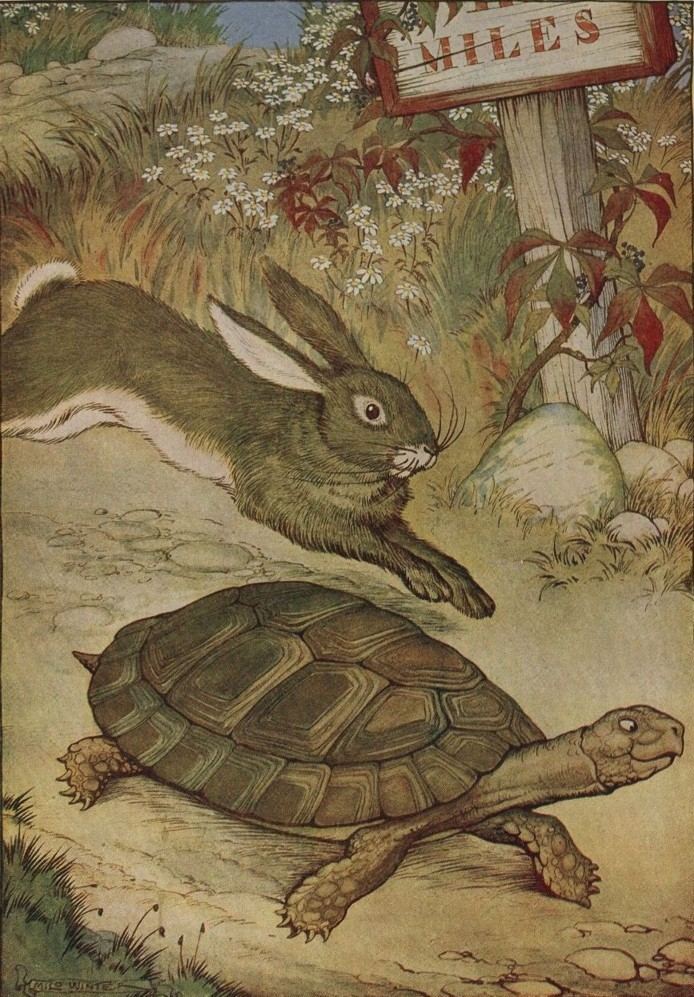
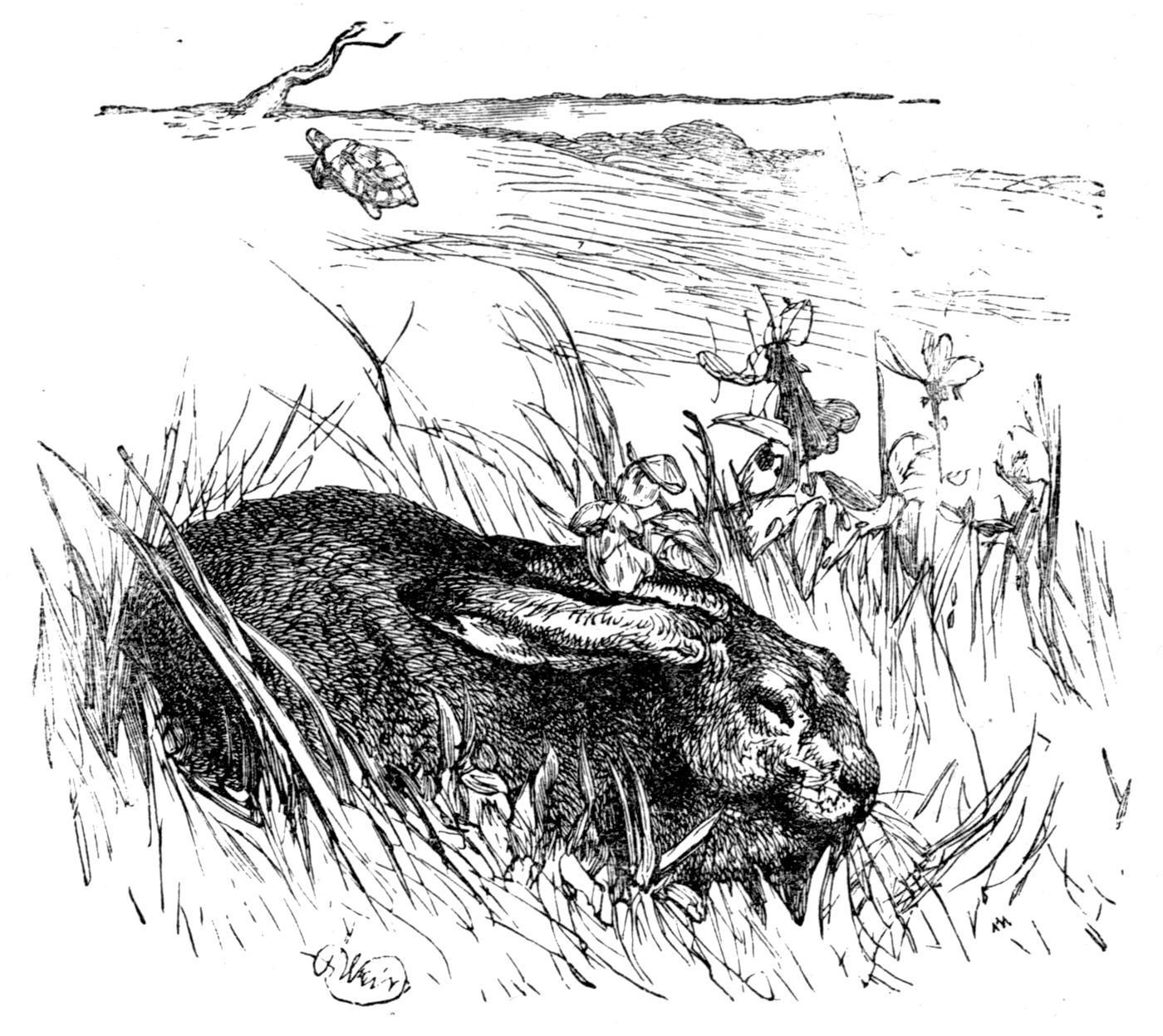
A tortoise and a hare argue about speed. They set a time and a place. The hare, trusting his natural quickness, stops caring about the race, flops down by the roadside, and sleeps. The tortoise, who knows exactly how slow she is, never stops running. There is no cheering crowd, no lesson about sustainable growth, no moment where the hare's strategy fails him. The hare loses because he took a nap.1
The reference number matters if you want to check this yourself. Laura Gibbs's index of Aesop's fables files this story as Perry 226 and lists the Greek witness as "Chambry 352."2 That is the text above.
II
"Slow and steady wins the race" is English, and it is late
The closing line of the Greek is one sentence:
Ὁ λόγος δηλοῖ ὅτι πολλάκις φύσιν ἀμελοῦσαν πόνος ἐνίκησεν.1
Word for word: the story shows that often toil has defeated a nature that stopped paying attention. Gibbs renders the same idea as "many people have good natural abilities which are ruined by idleness."2 The subject of the sentence is πόνος, labour. The villain is ἀμέλεια, not caring.
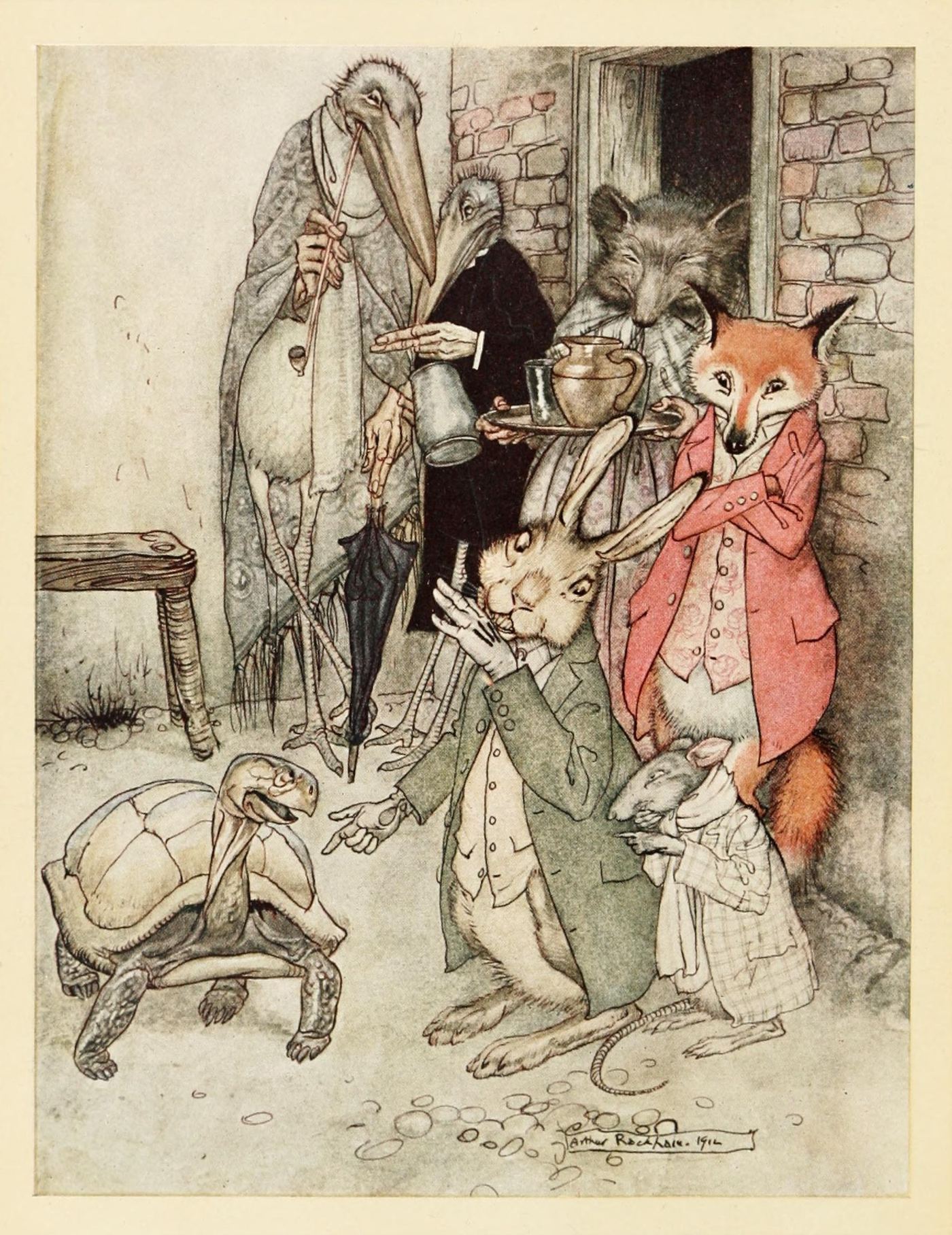
Compare the version almost everyone actually met as a child. V. S. Vernon Jones's 1912 translation, the one Arthur Rackham illustrated, ends: "Slow and steady wins the race."5 That is a good line. It is also an English editorial flourish, not a translation of the Greek sentence above. The Greek does not praise slowness. It praises not stopping.
That distinction is the whole argument. "Slow and steady" is advice about pace. "Effort beats neglected talent" is advice about attention. A company can move extremely fast and still be the tortoise, as long as nobody lies down.
III
Aesop is a character before he is an author
Herodotus, writing in the fifth century BCE, already treats Aesop as a known figure: he calls him "Esop the maker of fables," a slave of Iadmon of Samos, and mentions the blood money the Delphians paid for his death.3 So the tradition is genuinely old, and "over two thousand years" is safe as a statement about the tradition.
What is not safe is "Aesop warned us." Herodotus describes a teller, not a writer, and the Greek text quoted above reaches us through Émile Chambry's edition, published in Paris by Les Belles Lettres in 1927.4 Saying "Aesop wrote" is like saying Homer emailed. Say "the oldest surviving Greek version" and you are on solid ground.
IV
The hare's motto is real, and it is on file with the SEC
This part of the modern comparison checks out better than the fable part. In the letter Mark Zuckerberg included in Facebook's registration statement, dated February 1, 2012, under the heading "Move Fast," the prospectus reads:
We have a saying: "Move fast and break things." The idea is that if you never break anything, you're probably not moving fast enough.6
It is a filed document, not a legend. What is usually left out is the ending. At Facebook's f8 developer conference on April 30, 2014, TechCrunch reported that "Mark Zuckerberg joked on stage that Facebook's mantra has changed from 'Move Fast And Break Things' to 'Move Fast With Stable Infra,'" alongside a two-year guarantee of stability for core APIs.7 The hare, in other words, retired the slogan himself after ten years, at the point where breaking things cost more than it bought.
V
What the filings actually say about the crashes
"High-flying companies collapse overnight" is the weakest sentence in the usual telling, because it hides the evidence. Use documents instead.
WeWork Inc. told the SEC that on November 6, 2023, it and certain subsidiaries "filed voluntary petitions to commence proceedings under Chapter 11 of title 11 of the United States Code in the United States Bankruptcy Court for the District of New Jersey."8 That is a bankruptcy, precisely dated, from the company itself.
Theranos is a sharper case, and not the same kind of case. In March 2018 the SEC charged Theranos, Elizabeth Holmes, and Ramesh Balwani with "raising more than $700 million from investors through an elaborate, years-long fraud." The complaint alleged the company claimed its analyzer could run comprehensive blood tests from finger drops, when "Theranos' proprietary analyzer could complete only a small number of tests," and that it promised more than $100 million of 2014 revenue against "a little more than $100,000."9
Notice what those documents do not say. Neither one says the company failed because it moved too fast, and neither says it "built no real foundation." One is a restructuring filing. The other is a fraud complaint, which is a claim about lying, not about pace. And the mirror-image claim, that steady legacy companies reliably survive, has no source here at all. It is a hunch, and it should be labelled as one on screen.
Notes
-
"Αἰσώπου Μῦθοι/Χελώνη καὶ λαγωός," Βικιθήκη (Greek Wikisource), transcribed from Ésope, Fables, ed. and trans. Émile Chambry (Paris: Société d'édition "Les Belles Lettres," 1927), fable 352. Greek text quoted as displayed. https://el.wikisource.org/wiki/%CE%91%CE%B9%CF%83%CF%8E%CF%80%CE%BF%CF%85_%CE%9C%CF%8D%CE%B8%CE%BF%CE%B9/%CE%A7%CE%B5%CE%BB%CF%8E%CE%BD%CE%B7_%CE%BA%CE%B1%CE%B9_%CE%BB%CE%B1%CE%B3%CF%89%CF%8C%CF%82. ↩↩↩
-
Laura Gibbs, "The Tortoise and the Hare," Perry 226, Aesopica, translation from Gibbs, Aesop's Fables (Oxford: Oxford University Press, World's Classics, 2002). The page lists the concordance "Perry 226: Chambry 352 [Greek]" and notes that Perry's index is compiled in the appendix to Ben Edwin Perry, ed., Babrius and Phaedrus, Loeb Classical Library (Cambridge, MA: Harvard University Press, 1965). http://mythfolklore.net/aesopica/perry/226.htm. Note: the Gibbs version, from a different Greek recension, adds a fox as umpire; the Chambry text in note 1 has no fox. ↩↩
-
Herodotus, An Account of Egypt (Histories, Book II), trans. G. C. Macaulay, Project Gutenberg ebook 2131, sec. 134: "she was a slave of Iadmon the son of Hephaistopolis a Samian, and a fellow-slave of Esop the maker of fables." https://www.gutenberg.org/cache/epub/2131/pg2131.txt. ↩
-
"Μεταγραφή:Ésope - Fables - Émile Chambry.djvu," Βικιθήκη (Greek Wikisource), index page giving Publisher "Société d'édition «Les Belles Lettres»" and Year "1927." https://el.wikisource.org/w/index.php?title=%CE%9C%CE%B5%CF%84%CE%B1%CE%B3%CF%81%CE%B1%CF%86%CE%AE:%C3%89sope_-Fables-_%C3%89mile_Chambry.djvu&action=raw. ↩
-
Aesop, Aesop's Fables: A New Translation, trans. V. S. Vernon Jones, illus. Arthur Rackham, intro. G. K. Chesterton (New York: Avenel Books, 1912), "The Hare and the Tortoise." Project Gutenberg ebook 11339. https://www.gutenberg.org/cache/epub/11339/pg11339.txt. ↩
-
Facebook, Inc., Form S-1 Registration Statement, prospectus "Subject to Completion, Dated February 1, 2012," section "Letter from Mark Zuckerberg," subsection "Move Fast," U.S. Securities and Exchange Commission, EDGAR. https://www.sec.gov/Archives/edgar/data/1326801/000119312512034517/d287954ds1.htm. ↩
-
Josh Constine, "Facebook Themes f8 Around A 'Stable Mobile Platform,' Offers 2-Year API Stability Guarantee," TechCrunch, April 30, 2014. https://techcrunch.com/2014/04/30/facebook-api-guarantee/. ↩
-
WeWork Inc., Form 8-K, date of earliest event reported November 6, 2023, Item 1.03 "Bankruptcy or Receivership," U.S. Securities and Exchange Commission, EDGAR. https://www.sec.gov/Archives/edgar/data/1813756/000119312523271902/d522028d8k.htm. ↩
-
U.S. Securities and Exchange Commission, "Theranos, CEO Holmes, and Former President Balwani Charged With Massive Fraud," press release 2018-41, March 14, 2018. https://www.sec.gov/news/press-release/2018-41. ↩
Bibliography
Aesop. Aesop's Fables: A New Translation. Translated by V. S. Vernon Jones. Illustrated by Arthur Rackham. New York: Avenel Books, 1912. Project Gutenberg ebook 11339.
Constine, Josh. "Facebook Themes f8 Around A 'Stable Mobile Platform,' Offers 2-Year API Stability Guarantee." TechCrunch, April 30, 2014.
Ésope. Fables. Edited and translated by Émile Chambry. Paris: Société d'édition "Les Belles Lettres," 1927. Digitized on Greek Wikisource.
Facebook, Inc. Form S-1 Registration Statement. U.S. Securities and Exchange Commission, February 1, 2012.
Gibbs, Laura. "The Tortoise and the Hare." Perry 226. Aesopica. Accessed September 16, 2026.
Herodotus. An Account of Egypt. Translated by G. C. Macaulay. Project Gutenberg ebook 2131.
U.S. Securities and Exchange Commission. "Theranos, CEO Holmes, and Former President Balwani Charged With Massive Fraud." Press release 2018-41, March 14, 2018.
WeWork Inc. Form 8-K. U.S. Securities and Exchange Commission, November 7, 2023.
Named but not consulted
Perry, Ben Edwin, ed. Babrius and Phaedrus. Loeb Classical Library. Cambridge, MA: Harvard University Press, 1965. Cited at second hand through Gibbs's Aesopica concordance; not fetched. Babrius does not contain this fable.
Hausrath, August, ed. Corpus Fabularum Aesopicarum. Leipzig: Teubner. Named in the brief; no copy fetched, so nothing here rests on it.
Townsend, George Fyler, trans. Three Hundred Aesop's Fables. London: George Routledge and Sons, 1867. Known only through the Wikimedia Commons file record for its Harrison Weir illustration; the translation itself was not fetched.
The Verge, coverage of f8 2014. The expected article URL returned HTTP 404, so it is not cited.
Image credits
Milo Winter, The Aesop for Children, Chicago: Rand McNally, 1919. Public domain.
Harrison Weir, in George Fyler Townsend, Three Hundred Aesop's Fables, London: Routledge, c. 1867. Public domain.
Arthur Rackham, Aesop's Fables, London: Heinemann, 1912. Public domain.
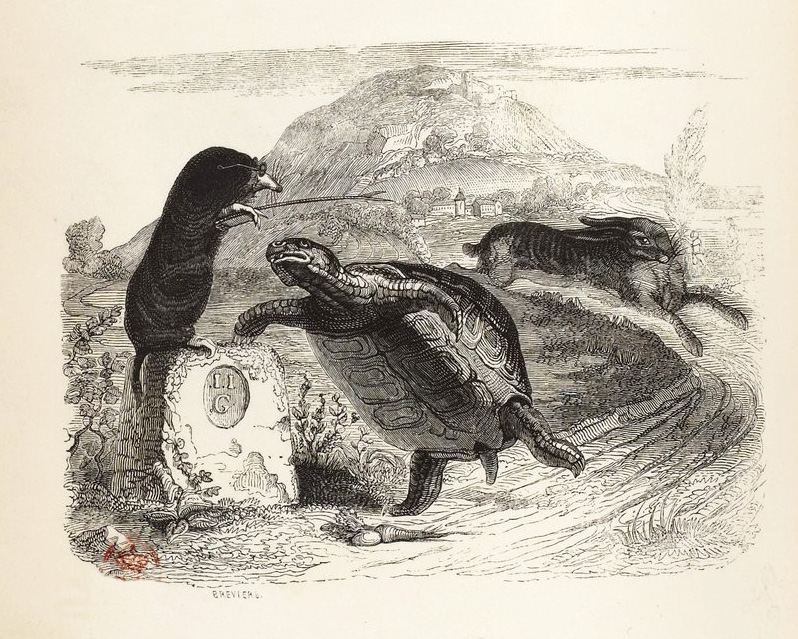
J. J. Grandville, Fables de La Fontaine, Paris: Fournier, 1838. Public domain.